

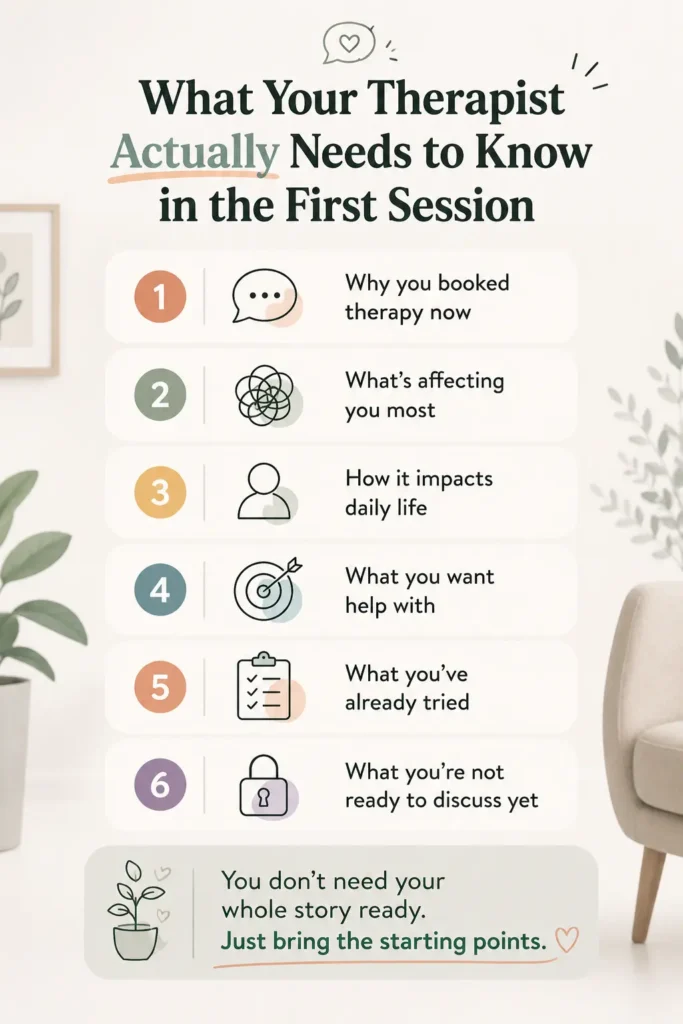
Before your first therapy session, the most useful things to tell your therapist are what brought you to therapy now, how the problem is affecting your life, what you want help with, what you have already tried, and anything important about your background or circumstances.
You do not need a diagnosis, a perfectly organized story, or your entire life history prepared. Your therapist’s job is to help you make sense of it with you.
What Would You Like Your Therapist to Know Before the First Session?
If you are staring at an intake form wondering what to write, start with these six things.
1. Why Are You Looking for Therapy Now?
You do not need to explain where every problem began. Start with what made you book the appointment.
For example: “I’ve always overthought things, but lately it is affecting my sleep.”
Or:
“Work has become overwhelming, and I’m taking that stress home.”
Or simply: “I don’t really know what’s wrong. I just know I haven’t felt like myself.”
That is enough to start.
Psychotherapy is designed to help understand troubling emotions, thoughts, and behaviors and how they affect everyday functioning.
2. How Is It Affecting Your Everyday Life?
“I’m anxious” gives your therapist some information. This gives them much more:
“I’m anxious enough that I avoid meetings and cannot sleep properly before work.”
Tell them what has changed in areas such as:
- Sleep
- Work or studies
- Relationships
- Appetite
- Motivation
- Socialising
- Concentration
- Things you have started avoiding
This helps your therapist understand how much the problem is affecting you, not just what you call it.

3. What Would You Like Therapy to Help You Change?
You do not need an impressive therapy goal.
“I want to be happier” is okay, but something more specific gives you both a clearer starting point.
For example:
- “I want to stop assuming every mistake means I’m failing.”
- “I want to communicate without shutting down during arguments.”
- “I want to be able to attend social events without avoiding them.”
- “I want to understand why I keep repeating the same relationship pattern.”
Therapy is usually collaborative, and treatment goals can include reducing symptoms, improving daily functioning, and improving quality of life.
And if you do not know your goal yet, say that. Figuring it out can be part of therapy.
4. What Have You Already Tried?
Tell your therapist what has and has not helped. That might include:
- previous therapy
- journaling
- meditation
- exercise
- talking to friends or family
- self-help books or apps
- avoiding certain situations
- medication prescribed previously
You are not being tested on whether you tried hard enough. This simply prevents the session from becoming a list of suggestions you have already attempted. If you have had therapy before, it is also useful to say what you liked or disliked about that experience.
5. What Should Your Therapist Understand About Your Life?
Therapy advice needs to work in your actual life.
If something about your family, culture, language, finances, relationship, sexuality, religion, or work situation changes how you experience the problem, tell your therapist.
For example:
- “Moving out isn’t realistically an option because I live in a joint family.”
- “I’d find it easier to discuss some things in Hindi.”
- “My family doesn’t know I’m coming to therapy.”
- “My relationship isn’t accepted at home.”
Good therapy should consider your circumstances rather than treating every client as though they live the same life. NIMH notes that treatment approaches should be matched to the person’s needs and situation.
If cultural fit matters to you, read How to Find a Therapist Who Understands Your Culture or Identity.
6. What Are You Not Ready to Talk About Yet?
You are allowed to say: “There is something important here, but I’m not ready to go into the details today.”
You do not have to tell your therapist your most painful experience simply because it is the first session.
The first appointment is often partly about understanding what you are struggling with now and deciding what kind of support may be appropriate. NHS talking-therapy services similarly use initial appointments to understand current difficulties and needs before deciding next steps.
Trust usually develops over time. Being honest that you are not ready is more useful than forcing yourself to disclose something because you think therapy requires it.
If You Don’t Know What to Say, Take This Note With You
You can save this on your phone and fill it in before your appointment:
I’m starting therapy because:
Recently I’ve been struggling most with:
It is affecting my:
I’d like therapy to help me:
I’ve already tried:
One thing I’d like my therapist to understand about me:
One thing I’m not ready to discuss yet:
You do not need to complete every line. Even three answers can give you somewhere to begin.
What If You Go Blank in the First Session?
Say exactly that.
“I had things I wanted to talk about, but now that I’m here, I’ve gone blank.”
A first therapy session can feel awkward because you are discussing personal things with someone you have just met. That does not mean the session is going badly. NHS guidance specifically notes that feeling awkward at first is common and encourages clients to tell the therapist what helps or what feels difficult.
Your therapist can ask questions and help organize the conversation.
For more on what actually happens during the appointment, read What to Expect in Your First Therapy Session.
Do You Need to Tell Your Therapist Everything?
No. You should try to be honest about information that affects your care, but honesty does not mean telling your entire story immediately.
You can:
- Ask why a question is being asked
- Say you do not know the answer
- Correct something you explained badly
- Return to a subject in a later session
- Tell your therapist when something feels difficult to discuss
Therapy depends heavily on trust and comfort with the person you are working with. NIMH describes rapport and trust as essential because therapy conversations are deeply personal.
The Bottom Line
You do not need to arrive at therapy with your life neatly summarised. Give your therapist the starting points:
What is happening? How is it affecting you? What would you like to change?
The rest can unfold over time.
If you are still looking for the right person to have that first conversation with, find a therapist on GetYourTherapy based on your concern, language, budget, and availability.