

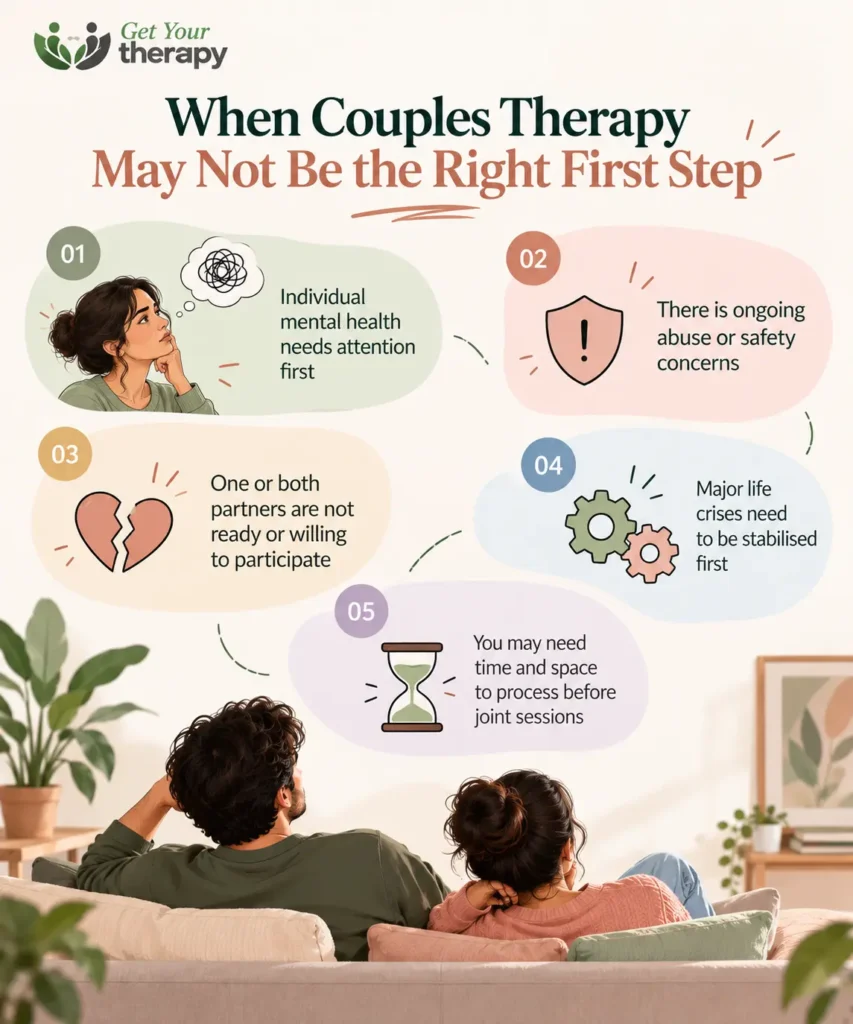
Couples therapy doesn’t work equally well for every relationship or situation. Sometimes the problem isn’t that therapy has “failed” it is that something else needs attention first, like safety, uncertainty about staying together, an individual crisis, or whether both partners genuinely want to participate.
Here are the situations where standard couples therapy may not be the best place to begin.
1. One Partner Is Afraid to Speak Honestly
Couples therapy depends on both people being able to say what is happening without fearing what will happen after the session.
That becomes a serious concern when a relationship involves:
- Threats
- Coercive control
- Intimidation
- Physical or sexual violence
- Monitoring or restricting someone’s movements
- Fear of retaliation for what is said in therapy
In these situations, standard joint counseling may not be safe.
Research on couples therapy and intimate partner violence is nuanced. Some carefully screened couples experiencing particular forms of situational violence may benefit from specialist conjoint treatment, but researchers stress the need for careful safety assessment and ongoing monitoring. It is not appropriate to assume that ordinary couples counseling is safe for every relationship involving violence.
If you cannot speak openly because you are afraid of your partner, seek individual professional support first.
2. One Partner Wants to Save the Relationship and the Other Has Already Decided to Leave
Imagine:
Partner A: “I’ll do anything to make this work.”
Partner B: “I’ve basically decided the relationship is over.”
They are not entering therapy with the same goal.
Traditional couples therapy usually assumes that both people are willing, at least temporarily, to work on the relationship.
For couples in which one partner is “leaning in” while the other is “leaning out,” discernment counseling is one option. Its purpose is not to repair the relationship immediately. It helps couples decide whether to stay as they are, separate, or genuinely try couples therapy.
Sometimes the first question is therefore not:
“How do we fix our relationship?”
It is:
“Do we both want to try?”
3. One Partner Is Being Forced Into Therapy
A reluctant partner can still benefit from counseling.
A partner who says:
“I’m nervous about this, but I’ll try.”
is very different from someone saying:
“I’m only here because you threatened me.”
Couples therapy requires some willingness to participate.
Research on couple and family therapy has found that the therapeutic alliance, how well clients and the therapist agree on the goals and work of therapy, is associated with better outcomes. More divided or unbalanced alliances are associated with poorer outcomes.
You cannot make another person engage meaningfully simply by getting them into the room.
If your partner refuses therapy completely, read What If My Partner Doesn’t Want Couples Therapy?.
4. You Are Expecting the Therapist to Decide Who Is Right
Couples therapy is unlikely to feel useful if the main goal is:
“I need a professional to tell my partner that I’m right.”
A couples therapist may point out harmful or unfair behavior. But their job is usually not to referee every disagreement.
They are more likely to examine questions such as:
- What keeps happening between you?
- How does each person respond?
- What turns a small disagreement into a major fight?
- What needs to change?
- Is each partner willing to take responsibility for their part?
If one person expects therapy to serve as evidence in their case against the other, progress can stall quickly.
5. A Serious Individual Problem Needs Immediate Attention
Sometimes relationship problems exist alongside something that requires its own treatment.
For example:
- An acute mental-health crisis
- Severe substance use
- Serious untreated trauma symptoms
- Immediate risk of self-harm
- Behavior that makes joint sessions unsafe or impossible
That does not automatically mean couples therapy should never happen.
In fact, specialized behavioral couples therapy has evidence for helping some couples where one partner has an alcohol or drug-use disorder. A meta-analysis found benefits for substance-use outcomes and relationship satisfaction compared with control conditions.
But the right order matters.
Individual, psychiatric, addiction, or crisis treatment may sometimes need to begin before or alongside relationship therapy.
A qualified therapist should help determine which problem needs attention first.
6. The Same Therapy Has Gone Nowhere for Months
Not seeing immediate improvement does not mean therapy is failing.
Some difficult issues take time.
But if you have attended for months and:
- Neither person understands what you are working towards
- Every session becomes the same uncontrolled argument
- The therapist consistently seems aligned with one partner
- There is no agreed treatment direction
- Neither partner feels heard
- Nothing changes despite discussing the same issue repeatedly
it is reasonable to review the therapy itself.
Ask:
“What are our goals, what progress have you noticed, and what should we be working on differently?”
The therapist-client alliance matters in couples therapy, so a poor fit shouldn’t automatically be interpreted as proof that all couples therapy will fail.
Sometimes changing therapist or therapeutic approach is more appropriate than abandoning therapy entirely.

7. One Partner Is Still Actively Hiding the Problem You Are Supposed to Be Repairing
Therapy cannot rebuild trust when a problem remains unchanged.
For example, if couples therapy is supposed to address an affair while the affair is secretly continuing, the couple is trying to rebuild trust without the conditions needed for trust.
The same problem can occur with ongoing financial deception or other major secrecy.
This does not always mean therapy must stop.
The focus may simply need to change from:
“How do we repair our relationship?”
to:
“What needs to happen before repair is realistically possible?”
If infidelity is the concern, read Can Couples Therapy Help After Infidelity?.
When Couples Therapy Is Worth Trying
Don’t use this list as a reason to wait until your relationship is nearly over. Couples therapy can be useful when:
- You keep having the same arguments
- Communication has become difficult
- Emotional or physical intimacy has changed
- Trust needs rebuilding
- In-laws or family boundaries are causing conflict
- You disagree about money, parenting, or responsibilities
- You feel increasingly disconnected
- Both of you want things to improve but cannot work out how
You don’t need a relationship crisis to ask for help.
The Bottom Line
Couples therapy can be effective, but “go to couples therapy” is not the correct answer to every relationship problem.
Sometimes safety needs to come first. Sometimes one partner needs individual support. Sometimes you first need clarity about whether both people actually want the relationship.
And sometimes couples therapy is still the right treatment, you simply need a therapist who fits your particular problem.
Read How to Find the Right Couples Therapist in India or find a therapist on GetYourTherapy.
Sources
- Karakurt et al. Systematic review and meta-analysis of couples therapy for intimate partner violence.
- Doherty, Harris & Wilde
- Reviewed by: Samya Kansal on 16/010/2026