
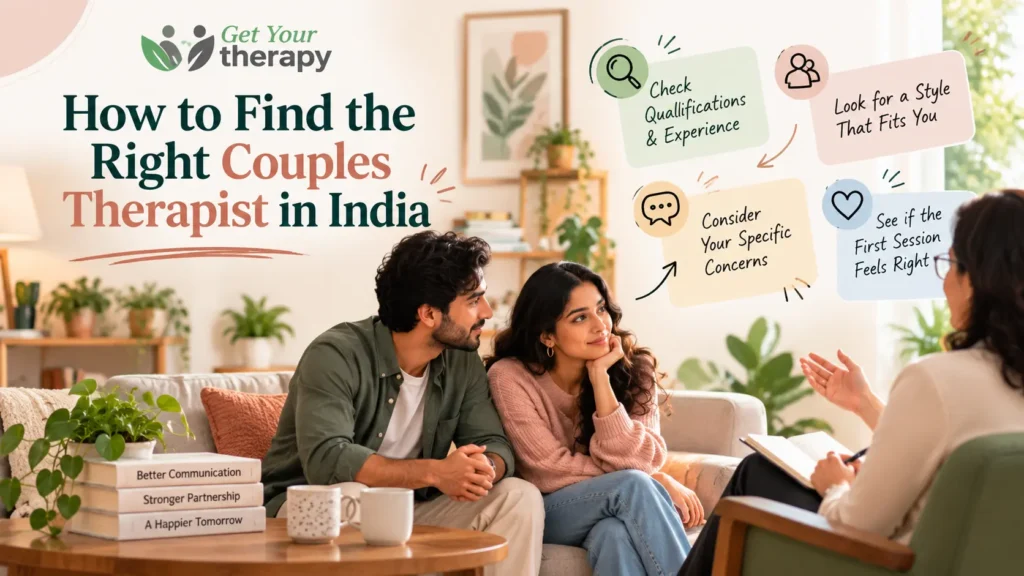
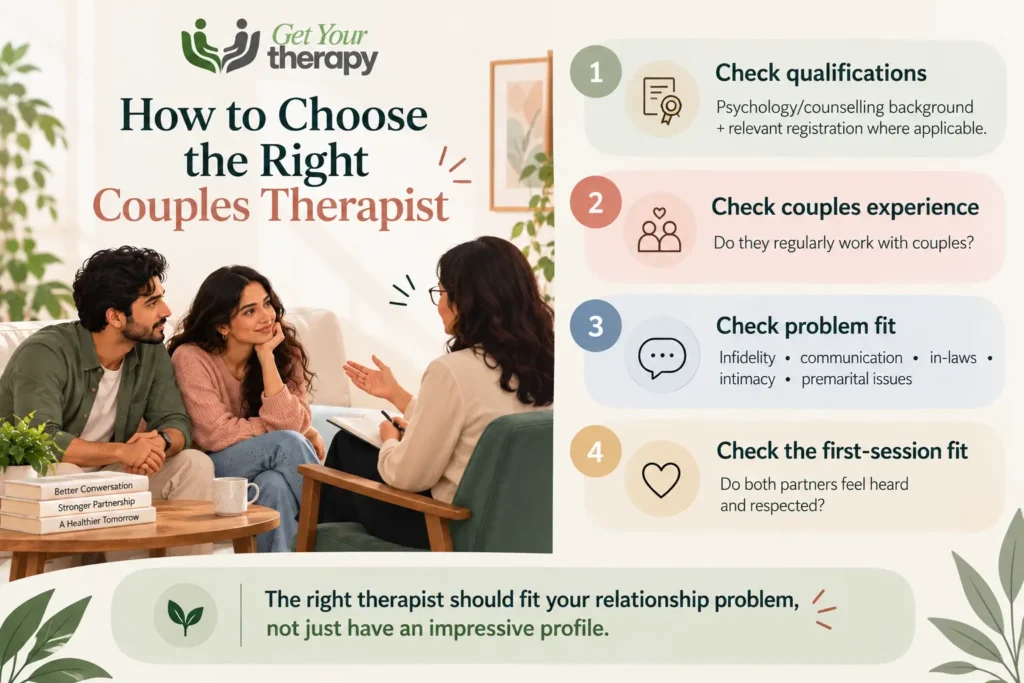
To find the right couples therapist in India, check four things: their core professional qualifications, specific training or experience with couples therapy, experience with your particular problem, and whether both partners feel heard in the first session.
Do not choose someone only because their profile says relationship expert, marriage counselor, or lists several therapy methods.
What Qualifications Should a Couples Therapist Have in India?
The term “couples therapist” alone does not indicate someone’s underlying professional qualifications.
Start by asking:
“What is your main mental-health qualification?”
If someone describes themselves as a clinical psychologist, check whether they have current Rehabilitation Council of India registration. Clinical psychologists are one of the professional categories registered in RCI’s Central Rehabilitation Register.
For other therapists or counsellors, look at:
- Their psychology or counselling education
- Where they trained
- Supervised clinical experience
- Couples-specific training
- How long they have worked with couples
A certificate in a relationship technique should be an additional qualification, not the only qualification you check.
Why Couples-Specific Experience Matters
Working with one person and working with two partners in the same room require different skills.
A couples therapist needs to notice:
- how arguments escalate
- who pursues and who withdraws
- whether one person dominates the conversation
- how each partner responds to criticism
- what happens when emotions become intense
- whether both people can speak safely
Ask directly:
“How much of your current work is actually with couples?”
Someone who occasionally discusses relationship problems in individual therapy is not necessarily experienced in couples therapy.
Find Someone Who Works With Your Actual Problem
“Couples therapy” covers very different concerns.
A therapist experienced with communication problems may not have the same experience working with infidelity, sexual concerns, or couples considering separation.
Ask whether they regularly work with your issue:
| Your concern | Experience worth asking about |
|---|---|
| Repeated arguments | Conflict and communication work |
| Infidelity | Affair recovery and rebuilding trust |
| Emotional distance | Attachment and intimacy |
| In-laws or joint family | Family systems and Indian family dynamics |
| Intimacy concerns | Couples work involving sexual concerns |
| Unsure whether to stay | Relationship decision-making |
| Premarital concerns | Premarital counselling |
For example, if you are recovering after an affair, ask specifically about couples therapy after infidelity, rather than simply whether they treat “relationship issues.”
Do EFT, Gottman, or Other Certifications Matter?
They can, but the name alone should not decide your choice.
You may see therapists mention:
- Emotionally Focused Therapy (EFT)
- Gottman Method
- Behavioral couples therapy
- CBT-based couples work
- Family systems approaches
These can give you useful information about how the therapist works.
But “trained in” can mean different levels of training. An introductory workshop is different from extensive supervised practice or full certification.
Ask:
“What training have you completed in this approach, and how would you actually use it with our problem?”
A strong answer should explain the therapy in normal language rather than simply listing certificates.
What Should You Ask Before Booking?
You do not need a 20-question interview.
Ask these five:
- What are your main qualifications?
- How much experience do you have working specifically with couples?
- Have you worked with couples dealing with our particular concern?
- What approach would you normally use for this problem?
- How do you handle private information if you meet partners individually?
You can usually get enough information from a therapist’s profile, email inquiry, or first consultation.
What Should a Good First Session Feel Like?
You do not need to leave thinking:
“This therapist completely understands our relationship already.”
But both partners should feel that they had space to speak.
Look for whether the therapist:
- listens to both perspectives
- interrupts destructive arguments rather than allowing them to take over
- asks questions instead of making quick assumptions
- explains what pattern they are noticing
- tells you what therapy may focus on
- avoids automatically choosing a “good partner” and “bad partner”
Couples therapy should be balanced without pretending both people are always equally responsible for every problem.
Read What Happens in a Couples Therapy Session? if you want to know what to expect from that first appointment.
Red Flags When Choosing a Couples Therapist
Consider looking elsewhere if the therapist:
- quickly takes one partner’s side
- promises to “save your marriage”
- cannot explain their qualifications
- cannot explain how they work with couples
- dismisses cultural or family context
- allows one partner to dominate every session
- pushes you towards staying together or separating
- ignores signs of fear, coercion, or abuse
The goal of couples therapy is not to preserve every relationship. It is to help both people understand what is happening and make healthier decisions.
Should Both Partners Choose the Therapist Together?
Ideally, yes.
If one partner selects the therapist entirely alone, the other may arrive already wondering:
“Is this your therapist or our therapist?”
A simple process works better:
Each person chooses two or three profiles → compare them → shortlist someone both are willing to meet.
You do not both need to feel equally enthusiastic. You should both feel comfortable giving the therapist a fair chance.
Does the Therapist Need to Understand Indian Family Dynamics?
For many couples, yes.
A relationship problem may involve:
- living with parents
- expectations from in-laws
- financial responsibility towards family
- arranged-marriage dynamics
- intercaste or interfaith relationships
- decisions about caring for aging parents
Generic advice such as “just cut them off” or “set a firm boundary” may not fit the practical reality of the relationship.
Ask:
“Do you have experience working with couples dealing with joint-family or in-law conflict?”
Specific experience matters more than a vague claim of being “culturally sensitive.”
Online or In-Person: Which Therapist Should You Choose?
Do not reject a stronger therapist simply because they are not in your city.
Online couples therapy may make it possible to work with someone who has specific experience with your concern.
Choose in-person instead if you cannot speak privately at home or both partners engage better face-to-face.
Our guide to Online Couples Therapy in India explains the evidence and practical differences.
The Bottom Line
The best couples therapist is not necessarily the person with the longest bio or the most certificates.
Look for someone who can answer three questions clearly:
What are you trained in? Have you worked with couples like us? How will you help with the problem we actually have?
Find a couples therapist in India
Sources
- Rehabilitation Council of India
- RelationshipInfo
- Couples-therapist selection guidance
- Reviewed by: Samya Kansal on 06/10/2026