

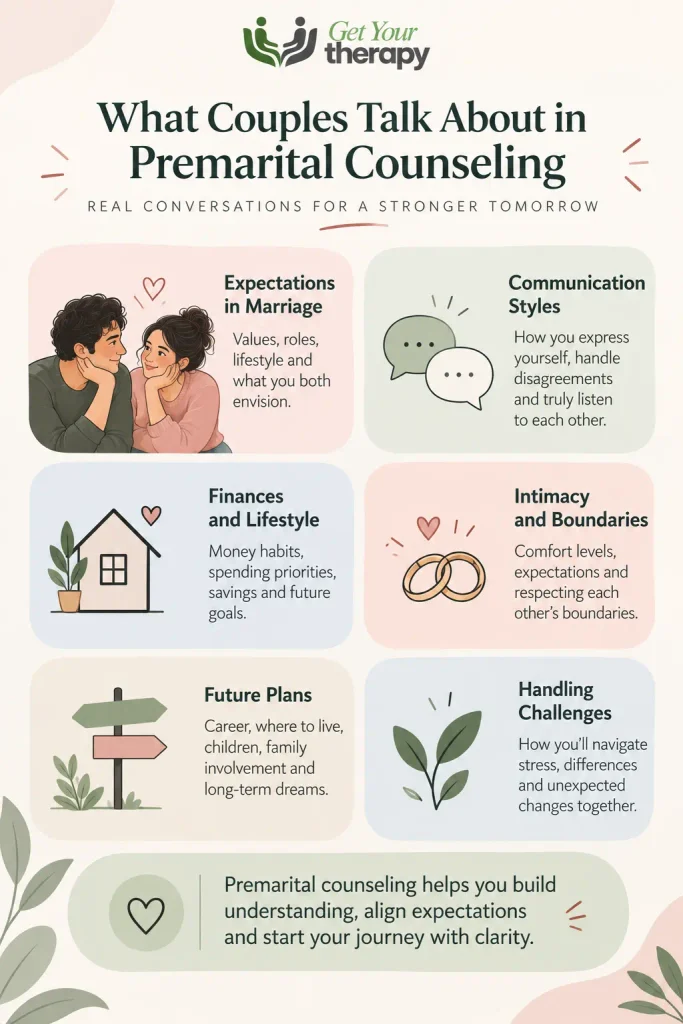
Premarital counseling helps couples discuss the decisions and expectations that often create conflict only after marriage. Typical conversations include money, where you will live, involvement of parents and in-laws, children, careers, household responsibilities, intimacy, religion, and how you handle disagreements.
You do not need relationship problems to go. The point is often to discover the assumptions you have before they become arguments.
What Do Couples Talk About in Premarital Counselling?
Most sessions focus on a few practical areas:
| Topic | Questions you may discuss |
|---|---|
| Money | How will we spend, save, and manage debt? |
| Family | How involved will parents and in-laws be? |
| Living arrangements | Alone, with family, or somewhere else? |
| Children | Do we want them? When? How would we parent? |
| Careers | What happens if one person needs to relocate? |
| Household roles | Who handles cooking, cleaning and other responsibilities? |
| Intimacy | What does physical and emotional closeness mean to us? |
| Conflict | What happens when we strongly disagree? |
| Values | How important are religion, traditions, and lifestyle choices? |
APA’s overview of premarital counseling similarly highlights areas such as finances, in-laws, intimacy, and conflict resolution.
1. Money: More Than “Who Earns More?”
Knowing each other’s salary is not the same as discussing money.
Premarital counselling may ask:
- Do we combine finances or keep some money separate?
- Does either person have debt?
- What counts as a large purchase that should be discussed?
- How much do we want to save?
- Will we provide financial support to parents or siblings?
- What happens if one partner stops working temporarily?
For many Indian couples, financial decisions involve not only the two partners but also the wider family. Discussing those expectations early can prevent both people from entering marriage with completely different definitions of financial responsibility.
2. Parents, In-Laws and Where You Will Live
This can be one of the most important conversations for couples in India.
One person may assume: “We’ll eventually get our own place.”
The other may assume: “Of course we’ll continue living with my parents.”
Neither assumption has been spoken aloud. Premarital counselling can help you discuss:
- Whether you will live with parents
- How often families will visit
- How decisions involving parents will be made
- Caregiving expectations
- Privacy within a joint family
- What happens when a partner and parent disagree
The goal is not to create perfect boundaries before marriage. It is to know what each person expects.
3. Children: “Someday” Is Not a Complete Plan
Couples often know whether the other person broadly wants children.
Fewer discuss:
- when they would want children
- what happens if conception is difficult
- how parenting responsibilities would be shared
- whether one partner would pause their career
- expectations around grandparents helping
- what values they want children raised with
You do not need every answer finalized. But major disagreements are easier to understand before a wedding than after one.
4. Careers and Relocation
What happens if one person receives a promotion in Bengaluru and the other has built a career in Delhi?
Or one partner wants to move abroad while the other wants to remain close to family?
Useful questions include:
- Whose career takes priority if both cannot?
- Would either of us relocate?
- What would happen if one person’s income becomes much higher?
The purpose is not to predict every future decision. It is to understand how you expect decisions to be made.
5. Household Responsibilities
Couples rarely fight because a dishwasher exists.
They fight because one person feels: “I am carrying everything, and you don’t notice.”
Discuss what each person expects around:
- Cooking
- Cleaning
- Shopping
- Bills
- Planning family events
- Caring for children
- Caring for parents
Do not rely on “we’ll work it out.” Talk about what fair actually means to each of you.
6. Intimacy and Sex
For many couples, especially where sex before marriage has been limited or avoided, this may be one of the hardest conversations.
Premarital counselling can provide a neutral space to discuss:
- Comfort with physical intimacy
- Expectations around frequency and affection
- Communicating consent
- Differences in desire
- Contraception and family planning
- Worries or misconceptions
A therapist should facilitate the conversation without judging either partner’s values or pressuring someone to disclose more than they are comfortable sharing.
7. Religion, Culture and Traditions
Different values may not feel important while dating but become more visible after marriage.
Discuss:
- Religious practices at home
- Festivals and ceremonies
- Food or lifestyle expectations
- Whether children will follow a religion
- Intercaste or interfaith family expectations
- How traditions from both families will be handled
The goal is not agreement on everything.
It is avoiding the sentence:
“I thought you already knew this mattered to me.”
8. How You Fight
One of the most useful parts of premarital counseling is understanding how to handle disagreements.
- One partner may want to solve the problem immediately.
- The other may need several hours alone.
- One experiences that space as healthy.
- The other experiences it as rejection.
Relationship-education research has found fairly consistent improvements in communication skills, although evidence for improving long-term relationship satisfaction is more mixed. A meta-analysis of 47 premarital education studies found stronger evidence for improved couple communication than for overall relationship quality.
That is a more realistic reason to consider premarital counseling than expecting it to “divorce-proof” a marriage.
Does Premarital Counselling Test Whether You Are Compatible?
No. A therapist should not give you a pass-or-fail result. You may discover important differences. The useful part is seeing whether you can:
- Discuss them honestly
- Understand each other’s position
- Negotiate where compromise is possible
- Identify genuine non-negotiables
Finding a disagreement during premarital counseling is not evidence your relationship has failed. Sometimes it is exactly what the counseling was supposed to uncover.
How Many Premarital Counselling Sessions Do Couples Need?
There is no standard number.
Some couples use a few focused sessions. Others need more time because they are dealing with major differences in family, religion, finances, or trust.
Research on marriage and relationship education suggests that programs with more than a very brief exposure can produce stronger outcomes than very low-dose programs, although results vary significantly between programs and couples.
Ask the therapist for their recommendation after you explain what you want to cover, rather than automatically purchasing a large package.

How Should You Choose a Premarital Counselor?
Look for someone who regularly works with couples and can comfortably discuss:
- Family systems
- Finances
- Intimacy
- Conflict
- Cultural expectations
Ask:
“What topics do you normally cover in premarital counselling, and how do you handle areas where we strongly disagree?”
If their approach is mainly giving generic relationship advice, keep looking.
For more on choosing a couples professional, read Couples Therapy in India: How It Works, Cost and What to Expect
The Bottom Line
Premarital counseling is not about searching for problems in an otherwise happy relationship.
It is about discovering the conversations you thought you had already had. Money. Parents. Children. Careers. Sex. Responsibilities. Conflict.
The fewer assumptions you carry silently into marriage, the more clearly you can decide what kind of marriage you are actually building.
Find a couples therapist in India
For more on how joint sessions work, read What Happens in a Couples Therapy Session?
Sources
- American Psychological Association
- Meta-analysis of marriage and relationship education involving 117 studies. PubMed
- Fawcett et al. ERIC
- Hawkins et al. PubMed