

Most people walk into their first therapy session not knowing what to expect. That uncertainty is often worse than the session itself.
Here is exactly what to expect in your first therapy session – what the therapist will ask, what you do not have to do, and how you might feel walking out.
How to Prepare for Your First Therapy Session?
Do not try to rehearse what you will say. You do not need a perfect summary of your problems or a clear self-diagnosis.
What actually helps before your first therapy session:
- Write down two or three things that brought you to therapy. Not a full story, just a few words. “Feeling anxious at work.” “Arguments with parents every week.” “Cannot sleep, cannot focus.”
- Note anything you are not ready to discuss yet. You are allowed to have limits from day one.
- If it is an online session, test your internet connection, find a private space, and use headphones if others are home.
For people in India specifically, privacy is a real problem in joint-family homes. If your house has shared rooms or thin walls, book your first therapy session during a time when you can step outside, sit in your car, or find a quiet corner. Your therapist will not judge this setup. Many Indian clients do exactly this.
What Happens in the First Five Minutes?
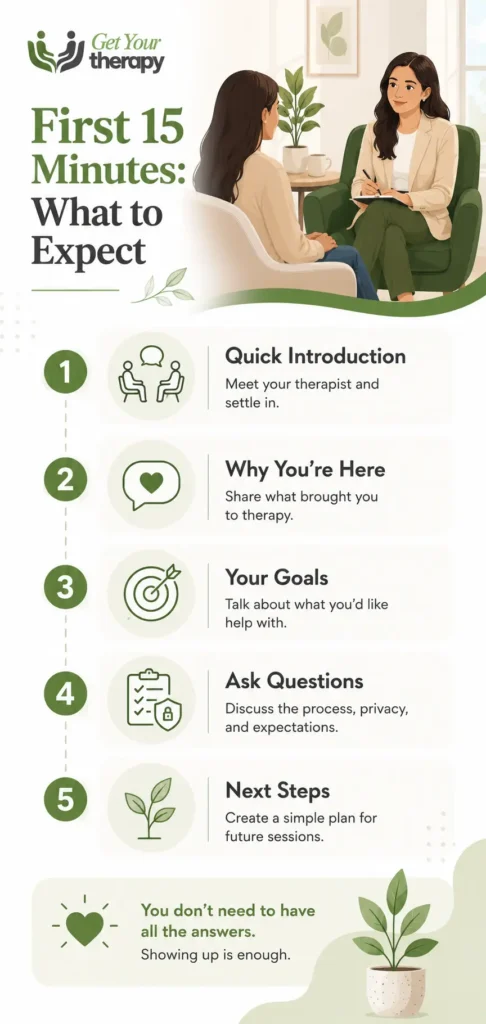
Your therapist will introduce themselves and briefly explain how they work – their approach, how they handle confidentiality, and what a typical session looks like. This is not small talk. It is they who are creating a foundation so you feel safe enough to speak honestly.
A good therapist will explain confidentiality before you ask. In India, therapists follow the ethical guidelines of the Rehabilitation Council of India (RCI). Everything you share stays private – with three exceptions:
- Immediate risk of harm to yourself or someone else
- A court order requiring disclosure
- A child’s safety is at risk
If your therapist does not mention confidentiality in the first session, ask them directly.
What the Therapist Will Ask You in the First Session?
Your first therapy session is an intake. Your therapist is building a picture of who you are and what brought you here. Common questions include:
- “What brings you in today?”
- “How long have you been feeling this way?”
- “Has anything changed recently in your work, relationships, or health?”
- “Have you been in therapy before? What worked or did not work?”
- “What would feel different if therapy helped you?”
These questions are open-ended on purpose. There are no right or wrong answers. Your therapist is listening for patterns, not testing you.
What You Do NOT Have to Do in Your First Therapy Session?
This is what no other guide tells you – and what most first-timers get wrong.
You do not have to tell your therapist everything in the first session. Do not have to cry, talk about your childhood, or explain your entire family history. You do not have to be ready for therapy.
Your first therapy session is an introduction. It is completely okay to say, “I am not ready to talk about that yet.” A therapist who pushes past that in session one is not the right fit for you.
In India specifically, Many people arrive at their first therapy session carrying shame – shame about seeking help at all, about what they are going through, about what their family would think if they knew. You do not have to justify any of that. Showing up is enough.
How Long Is the First Therapy Session?
Most first therapy sessions run 50 to 60 minutes. Some therapists start with a shorter 30-minute intake call, then move to full sessions from week two.
In India, online sessions on platforms like GetYourTherapy, Amaha, or Rocket Health typically run 45 to 60 minutes. In-person sessions at private clinics in Delhi, Mumbai, Bengaluru, or other cities follow the same standard.
The first session almost always feels shorter than it is. That is normal.
How You Will Feel After Your First Therapy Session
There is no single way the first session feels. All of these are common and all of them are okay:
- Relief: Many people feel lighter after their first therapy session just from saying out loud what they have been carrying silently for months.
- Emotional tiredness: Talking about difficult things, even briefly, takes real energy. Feeling drained after your first session is not a bad sign.
- Unsettled: Sometimes the first therapy session surfaces something you had not quite named before. That discomfort means the work has started.
- Underwhelmed: Some people expect an immediate breakthrough and find the first session feels more like a job interview than therapy. That is because the first session is groundwork, not the therapy itself. Deeper work begins from session two or three.
None of these reactions means therapy will not work for you.
How Many Sessions Before You Know If a Therapist Is the Right Fit?
Give it at least three sessions before deciding.
The relationship between you and your therapist is the single biggest factor in therapy outcomes – bigger than the technique used or the therapist’s years of experience. This is backed by research from the American Psychological Association. That relationship takes time to build. Three sessions give you enough to know whether it is forming.
If, after three sessions, you still feel unheard, judged, or uncomfortable in a way that goes beyond normal first-time nerves, it is completely reasonable to find someone else.
7 Red Flags That Mean Your Therapist Is Not the Right Fit
How to Switch Therapists Without Feeling Guilty
Ready to Book Your First Therapy Session?
At GetYourTherapy, you can find a therapist in India and globally – filtered by language, concern, budget, and session format. No referral needed.
Book your first therapy session
Also read:
Sources:
- American Psychological Association – The Therapeutic Alliance and Therapy Outcomes
- Rehabilitation Council of India – Code of Ethics for Clinical Psychologists
- ICMR Teletherapy Effectiveness Study, 2021
- National Institute of Mental Health – Psychotherapy: What You Should Know