

CBT for anxiety is a structured form of therapy that helps you understand how anxious thoughts, physical sensations and avoidance behaviours keep influencing one another. Instead of only discussing why you feel anxious, you and your therapist practise changing the patterns that keep the anxiety going.
CBT can help with generalised anxiety, social anxiety, panic attacks, phobias, exam anxiety and OCD—although the exact techniques should be adapted to the type of anxiety you experience.
Quick Answer: What Happens in CBT for Anxiety?
During CBT, you usually:
- Identify situations that trigger anxiety.
- Notice the thoughts and predictions that appear.
- Understand how avoidance or reassurance keeps the fear going.
- Practise responding differently.
- Test these new responses between sessions.
CBT is collaborative. Your therapist does not simply tell you to “think positively.” You work together to understand whether your anxious predictions are accurate and gradually practise situations you have been avoiding.
How Does CBT Work for Anxiety?
Anxiety often follows a cycle:
Situation → anxious prediction → physical symptoms → avoidance → temporary relief → stronger anxiety next time
For example, imagine you have to present something during a team meeting.
You think, “I will forget everything and everyone will judge me.” Your heart begins racing, so you ask a colleague to present instead. You feel relieved, but your mind learns that avoiding the presentation protected you.
The next meeting then feels even more difficult.
In CBT, you may work on:
- questioning the prediction that everyone will judge you
- reducing habits such as over-rehearsing or repeatedly seeking reassurance
- learning how to respond to physical anxiety symptoms
- gradually speaking during meetings rather than avoiding them completely
This is one reason CBT is widely recommended for anxiety disorders. NICE includes CBT among its main evidence-based psychological treatments for generalised anxiety and panic disorder.
What Should You Expect in Your First CBT Session?
The first session is usually about understanding your anxiety rather than immediately trying to “fix” it.
Your therapist may ask:
- When did the anxiety begin?
- What situations trigger it?
- What thoughts appear in those moments?
- What do you avoid because of anxiety?
- How is it affecting your work, studies, sleep or relationships?
- What would you like to be able to do differently?
You and the therapist may then agree on one or two clear goals.
A goal such as “I never want to feel anxious again” is difficult to measure. A CBT goal is more likely to be:
“I want to attend meetings without avoiding speaking.”
Or:
“I want to complete mock exams without panicking and quitting halfway.”
Read What to Expect in Your First Therapy Session for a broader explanation of how the first appointment usually works.
What Happens in Later CBT Sessions?
CBT sessions generally have more structure than an open-ended conversation.
A session may include:
- reviewing what happened during the week
- discussing one recent anxiety-triggering situation
- identifying thoughts and behaviours connected to it
- learning or practising a CBT technique
- agreeing on something to try before the next session
Your therapist may ask you to track anxious thoughts, practise a conversation, complete a mock test or gradually face a feared situation.
This work between sessions is not school-style homework. It is how you test whether what you discussed in therapy works in real life.
Does CBT Look Different for Different Anxiety Problems?
Yes. “CBT” should not mean using the same worksheet for every person.
| Anxiety concern | What CBT may focus on |
|---|---|
| Generalised anxiety | Excessive worry, uncertainty and repeated reassurance |
| Social anxiety | Fear of judgment, self-focused attention and avoided situations |
| Panic attacks | Fear of physical sensations and the panic cycle |
| Specific phobias | Gradual exposure to the feared object or situation |
| Exam anxiety | Fear of failure, perfectionism and practice under exam conditions |
| OCD | Exposure and Response Prevention, a specialised CBT approach |
For OCD, ask whether the therapist has specific training in Exposure and Response Prevention (ERP). General anxiety counselling is not always enough.
Read Types of Anxiety Disorders to understand which anxiety pattern most closely resembles what you are experiencing.
How Many CBT Sessions Are Needed for Anxiety?
There is no fixed number that works for everyone.
The length of therapy depends on the type and severity of anxiety, your goals and whether other concerns are also involved. For adults receiving high-intensity CBT for generalised anxiety, NICE describes a course of around 12–15 weekly sessions, although other anxiety conditions may use different treatment plans.
Your therapist should review progress with you rather than promising that your anxiety will disappear after a particular number of sessions.
How Do You Find a Qualified CBT Therapist in India?
There is no separate Indian licence called an “RCI-certified CBT therapist.” CBT is a therapy approach, while RCI registration applies to recognised professional categories such as clinical psychologists.
When choosing a therapist, check:
Their main professional qualification
If someone describes themselves as a clinical psychologist, ask for their active Central Rehabilitation Register number. RCI states that recognised clinical psychologists are registered through the CRR and must maintain valid registration.
Their actual CBT training
Ask where they learned CBT, whether the training included supervision and how frequently they use CBT with anxiety clients.
Completing a short introductory workshop is not the same as supervised clinical experience.
Their experience with your anxiety pattern
A therapist may understand CBT generally but have limited experience with panic disorder, OCD, social anxiety or exam anxiety.
Ask directly:
“How would you usually use CBT for the kind of anxiety I am experiencing?”
A good therapist should be able to explain the process in plain language.
How Much Does Online CBT Cost in India?
CBT is not normally charged differently from other individual therapy sessions.
As of July 2026, publicly listed Indian pricing commonly places online psychologist sessions at approximately ₹800–₹2,500 per session, although fees may be higher for senior or specialised clinicians. Prices vary by experience, session length and platform.
Before booking, ask:
- How long is each session?
- Is the fee the same for follow-up sessions?
- Are reduced-fee or sliding-scale places available?
- How frequently will sessions be recommended?
- Is cancellation or rescheduling chargeable?
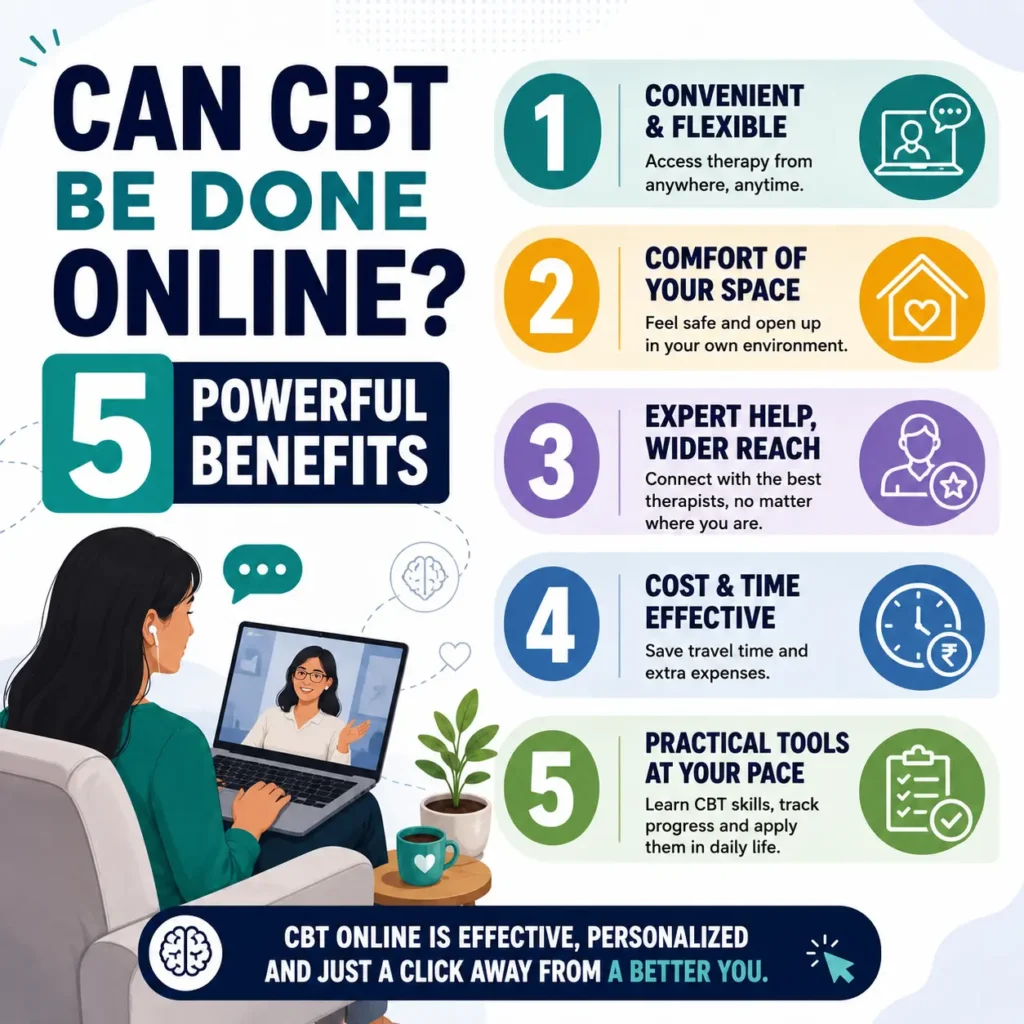
Can CBT Be Done Online?
Yes. Online CBT may include the same conversations, exercises and between-session practice as in-person CBT.
Research reviews have found that therapist-supported internet CBT can reduce anxiety symptoms, although results depend on the quality of the programme, therapist involvement and whether the person completes the work consistently.
Online sessions may be especially practical if you cannot find an anxiety specialist nearby. The therapist’s qualifications and experience still matter just as much online.
Is CBT Right for You?
CBT may be a good fit when you want therapy that is:
- structured and goal-focused
- connected to present-day problems
- practical between sessions
- transparent about what you are working on
- willing to gradually address avoidance
It may feel less suitable if you currently want open-ended exploration without structured exercises. A good therapist can explain whether CBT, another approach or a combination would better match your needs.
For help choosing, read How to Find a Therapist for Anxiety in India.
The Bottom Line
CBT works best when it is more than a therapist mentioning the term on their profile.
Look for someone who can explain your anxiety pattern, show how the sessions will address it and help you practise changes outside the therapy room.
At GetYourTherapy, you can compare therapists by concern, experience, language, session format and availability.