

Yes, couples therapy can help after infidelity but it cannot guarantee that the relationship will stay together. Therapy can help both partners understand what happened, manage the immediate emotional fallout, rebuild trust where possible and decide whether they genuinely want to continue the relationship.
Research on couples affected by infidelity has found improvement during therapy, although affair recovery is often difficult and the evidence is smaller than for couples therapy overall.
What Does Couples Therapy After Infidelity Actually Work On?
The first goal is usually not forgiveness. Therapy may initially focus on:
- Understanding what happened
- Dealing with anger, shock or repeated questions
- Establishing whether the affair is still continuing
- Creating enough safety to have difficult conversations
- Understanding what each partner wants now
- Deciding whether trust can realistically be rebuilt
- The partner who was betrayed may want details and reassurance.
- The partner who had the affair may feel guilt, shame or frustration about repeatedly discussing what happened.
A therapist helps keep those conversations from turning into the same painful fight every time.
Can Trust Be Rebuilt After Cheating?
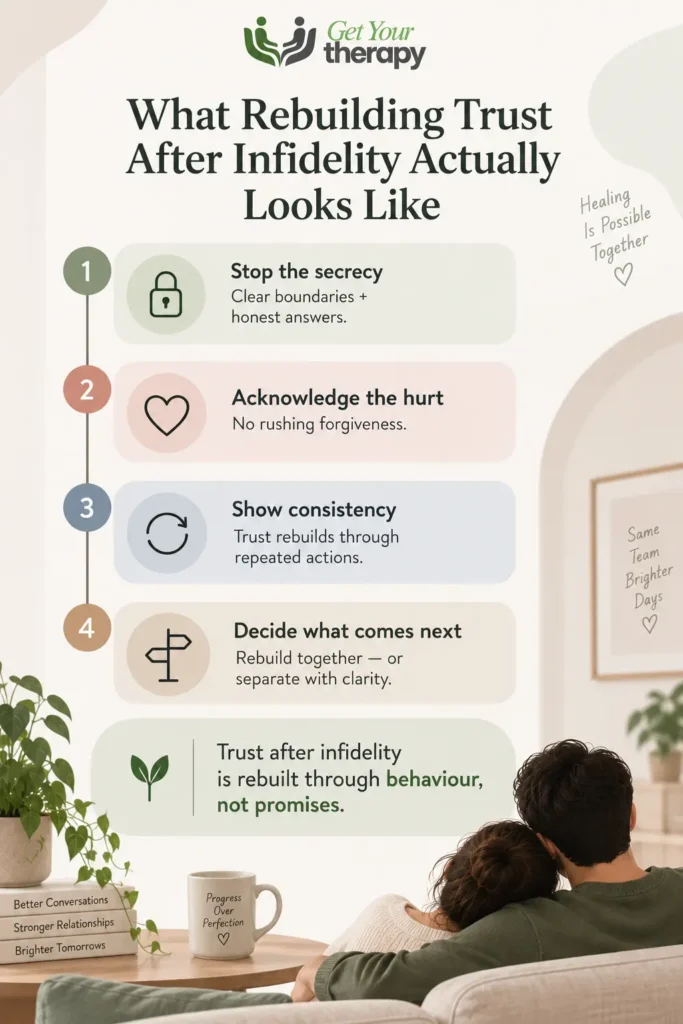
Sometimes but trust is rebuilt through behaviour, not promises.
That may mean:
- Being consistent about agreed boundaries
- Answering reasonable questions honestly
- Stopping further secrecy
- Acknowledging the impact of the betrayal
- Following through on commitments
- Allowing trust to return gradually
Research with couples recovering from affairs has identified communication, rebuilding safety and trust, commitment to the relationship and the healing process as important parts of recovery.
Therapy should not pressure the betrayed partner to “move on” before they feel ready.
Does Couples Therapy Mean You Have to Stay Together?
No. Some couples enter therapy knowing they want to repair the relationship. Others are asking:
- “Can I ever trust them again?”
- “Do I even want this marriage anymore?”
- “Are we staying because we want to or because separating feels too difficult?”
Couples therapy can help clarify those questions.
A successful outcome is not automatically staying married. Sometimes the useful outcome is understanding the relationship clearly enough to make a thoughtful decision about whether to continue.
What Happens in Infidelity Counselling?
Therapy usually moves through several overlapping areas.
1. Understanding the immediate impact
The betrayed partner may experience intrusive thoughts, anger, anxiety, difficulty sleeping or a strong need to understand exactly what happened.
The therapist first helps both partners manage that period without expecting normal relationship communication immediately.
2. Understanding the affair without excusing it
Later, therapy may explore what was happening in the relationship and in the individual partner’s life before the affair.
This is not the same as blaming the betrayed partner.
Understanding contributing factors and holding someone responsible for their choice can happen at the same time.
3. Rebuilding the relationship
If both partners want to continue, therapy may work on:
- Trust
- Communication
- Intimacy
- Boundaries
- Unresolved resentment
- Future expectations
A randomized trial of couples receiving therapy after a recently disclosed affair found improvement in anxiety for both partners, although relationship satisfaction did not improve enough for every couple and dropout was substantial.
That is important: therapy can help, but affair recovery is not simple or guaranteed.
What If the Affair Is Still Going On?
Therapy becomes much harder when the relationship outside the partnership is continuing or when new information keeps emerging.
The couple cannot meaningfully rebuild trust while the conditions causing the mistrust are still active.
This does not mean you cannot see a therapist while deciding what to do. But the focus may initially be on clarity and decision-making, rather than repairing trust.
Should You Ask for Every Detail About the Affair?
Not necessarily. Some information may help you understand what happened and make decisions. Other highly detailed information may create additional distress without helping recovery.
Instead of trying to learn every detail in one conversation, a therapist can help you distinguish between:
Information you need to make sense of the relationship
and
information you feel compelled to keep asking for because anxiety temporarily reduces when you receive another answer.
There is no single correct amount of disclosure for every couple. For more on what the first appointment involves, read What Happens in a Couples Therapy Session?
How Long Does Couples Therapy After Infidelity Take?
There is no fixed number of sessions.
Recovery depends on factors such as:
- Whether the affair has ended
- How long the deception continued
- Whether information is still being discovered
- The relationship before the affair
- Whether both partners want to continue
- Whether trust is gradually being rebuilt
Infidelity couples often begin therapy with higher relationship distress than couples seeking help for other reasons. Research has nevertheless found that some couples show substantial improvement through treatment and follow-up.
Avoid anyone promising to “repair your marriage in five sessions.”
What Should You Look for in a Therapist?
Ask directly: “How much experience do you have working with couples after infidelity?”
Also ask:
- What couples-therapy approach do you use?
- How do you handle disclosure about the affair?
- Do you meet partners individually?
- What is your policy around information shared privately?
- How do you work when one partner is unsure about staying?
Infidelity is a specific and difficult couples-therapy concern. General individual counselling experience does not automatically mean someone has experience helping couples through betrayal.
Read Couples Therapy in India: How It Works, Cost and What to Expect before choosing someone.
When Couples Therapy May Not Be the Right First Step?
If the relationship involves violence, coercive control, threats or fear of retaliation, standard joint therapy may not be safe.
Individual specialist support and safety planning should come first.
Likewise, if one partner is being forced into therapy purely to obtain forgiveness or prevent separation, meaningful couples work may be difficult.
The Bottom Line
Couples therapy after infidelity is not about forcing forgiveness or saving the relationship at any cost. It is about creating enough honesty and structure to answer two questions:
Can trust be rebuilt? And do both of us genuinely want to try?
If you are ready to explore those questions, find a couples therapist in India.