

If your partner doesn’t want couples therapy, you can still get support, but you cannot do true couples therapy alone. Individual therapy can help you understand your own reactions, boundaries, and decisions, while joint couples therapy requires both partners to participate.
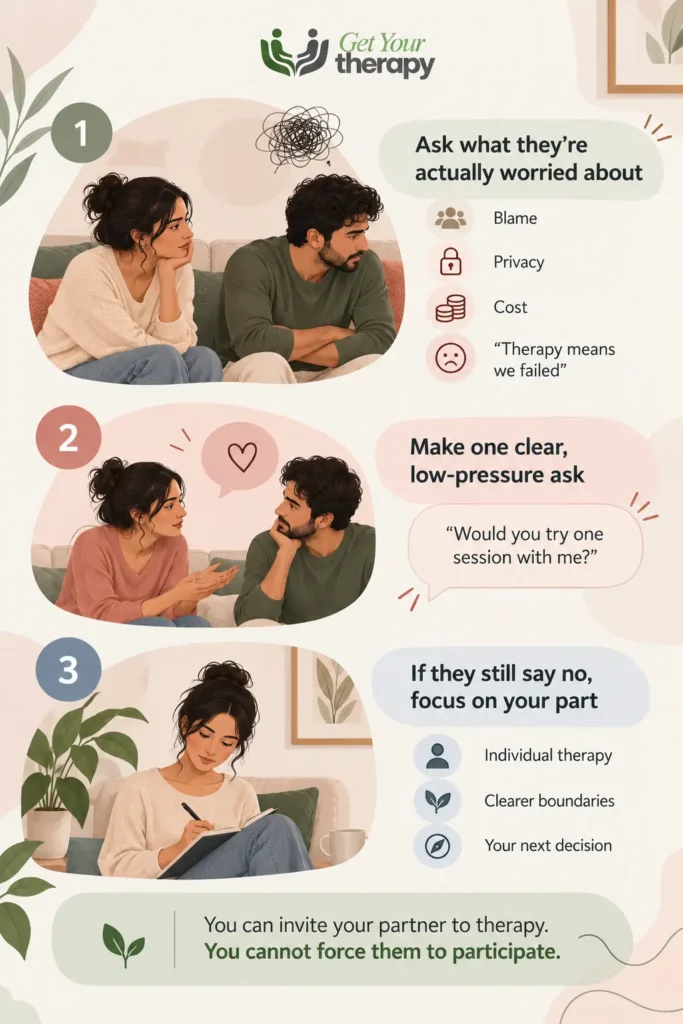
The first step is not to keep convincing them. Find out what they are actually saying no to.
Why Might Your Partner Refuse Couples Therapy?
“No” can mean very different things.
Your partner may think:
- “The therapist will take your side.”
- “Our problems aren’t serious enough.”
- “Talking about it will make things worse.”
- “I don’t want a stranger knowing our personal life.”
- “Therapy means our relationship has failed.”
- “I already know you’re going to blame me.”
- “I don’t think this relationship can be fixed.”
Until you understand the reason, repeatedly saying “we need therapy” may only create another argument.
Try asking: “What worries you most about going?”
The answer tells you much more than the refusal itself.
How Should You Bring Up Couples Therapy?
Talk about the problem you want help with, not what is wrong with your partner.
Instead of: “You need therapy because you never listen.”
Try:
“We keep having the same argument, and what we’re doing isn’t helping. I’d like us to have someone help us understand the pattern.”
Keep the first ask small.
You are not asking them to commit to six months of therapy. You can ask whether they would be willing to attend one introductory session and decide afterward whether it feels useful.
You can also show them what actually happens in a couples therapy session if fear of the unknown is part of the resistance.
Can You Do Couples Therapy Alone?
Not exactly.
Couples therapy treats the interaction between two partners, so a therapist cannot fully observe or work with the relationship when only one person attends.
However, you can go to individual therapy about relationship problems.
Research literature recognizes individual therapy for couple problems as a common option when a partner refuses joint therapy, but it also has limitations: the therapist hears only one person’s perspective and cannot directly address the interaction between the partners.
Individual therapy may still help you:
- Understand your part in repeated conflict
- Communicate more clearly
- Decide what boundaries you need
- Manage anxiety or anger around the relationship
- Understand what you can and cannot change
- Decide whether you want to remain in the relationship
The goal should not be:
“Teach me how to fix my partner.”
Your partner is the part of the relationship you cannot control.

Can the Relationship Improve If Only One Person Goes to Therapy?
Sometimes one person’s changes can affect the relationship, but there is no guarantee.
If you stop escalating every disagreement, communicate more clearly, or set healthier boundaries, your partner may respond differently.
But some problems require two people.
That distinction matters.
You cannot rebuild trust alone if dishonesty continues. You cannot improve communication if the other person refuses to engage in conversation. And you cannot make someone invest in a relationship they no longer want.
Research on individual therapy for relationship problems specifically cautions that working with only one partner creates structural limits on how much the relationship itself can be changed.
What If Your Partner Says the Relationship Is Fine?
Ask what they think about the specific problem, rather than whether the entire relationship needs therapy.
For example:
“Do you think the way we’re arguing is working?”
or:
“Are you happy with how we handle decisions about your parents?”
Two people can disagree about whether they “need therapy” while agreeing that something in the relationship is not working.
That gives you something more useful to begin with.
If you’re unsure whether the issue has reached that point, read 9 Signs You May Need Couples Therapy.
What If One Partner Is Unsure About Staying in the Relationship?
This is different from simply being skeptical about therapy.
If one partner wants to save the relationship while the other is seriously considering separation, traditional couples therapy may begin with two people working towards different goals.
An approach called discernment counseling was developed specifically for these “mixed-agenda” couples. Its goal is not to immediately repair the relationship, but to help both partners gain clarity on whether to continue as they are, remain separate, or make a serious attempt at couples therapy.
It is not widely available everywhere in India, but the idea is useful: sometimes the first question is not “How do we fix this?” It is “Do we both want to try?”
When Should You Stop Trying to Convince Them?
A partner does not have to love the idea of therapy.
But there is a difference between:
“I’m uncomfortable with therapy.”
and
“I refuse therapy, I refuse to talk about the problem, and I refuse to change anything.”
At some point, the question stops being:
“How do I get them into therapy?”
and becomes:
“What am I willing to live with if nothing changes?”
Individual therapy can be particularly useful at that stage because it gives you space to think without turning every conversation with your partner into another attempt to persuade them.
What If Your Partner Is Afraid the Therapist Will Take Sides?
That fear is common enough to discuss before booking.
A couples therapist should focus on the interaction between both partners rather than entering the room to prove one person right.
You can suggest choosing the therapist together. Look through profiles separately and shortlist someone you both feel comfortable trying.
Our guide to Couples Therapy in India explains what to check before booking.
The Bottom Line
You cannot force someone to participate meaningfully in couples therapy.
What you can do is understand why they are resisting, make a clear request, work on your own part of the relationship, and decide what you need if nothing changes.
Sometimes one partner starting individual therapy is the most useful next step.
Find a therapist on GetYourTherapy
Sources
- American Psychological Association — Helping Couples on the Brink of Divorce: Discernment Counseling.
- Reviewed by: Samya Kansal on 24/09/2026