

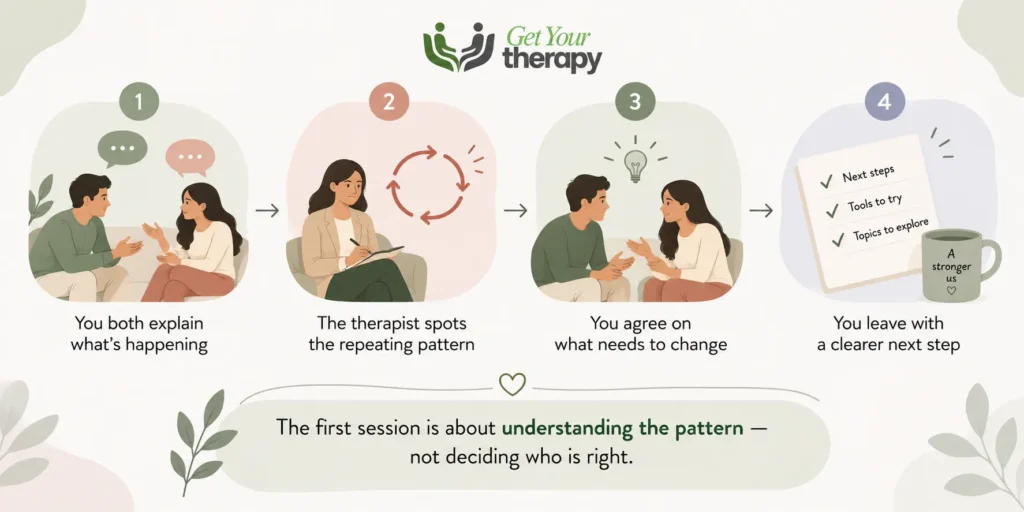
In a couples therapy session, the therapist listens to both partners, identifies recurring relationship patterns, and helps you work through the problem together. The first session is usually more about understanding what has been happening than trying to solve the relationship in one hour.
You can disagree about why you are there. You do not need to arrive with the same version of the problem.
What Happens in the First Couples Therapy Session?
Most first sessions follow a simple process:
- The therapist explains how couples therapy works.
- Both partners describe why they came.
- You discuss the relationship history and current concerns.
- The therapist starts identifying recurring patterns.
- You discuss what you would like to change.
- The therapist explains possible next steps.
In some approaches, the therapist may also meet each partner individually or use questionnaires as part of the assessment. For example, Gottman Method couples therapy commonly begins with a joint session followed by individual interviews before a treatment plan is developed.
What Will the Therapist Ask You?
Expect practical questions rather than a test of how good your relationship is.
Your therapist may ask:
- What made you book therapy now?
- What arguments keep repeating?
- When did things start feeling different?
- What happens when you try to solve the problem yourselves?
- What is still working well between you?
- What would you like to be different?
- Have there been major changes involving work, family, trust, parenting or intimacy?
For couples in India, conversations may naturally involve in-laws, living with family, marriage expectations, financial responsibilities towards parents or disagreements about where to live.
You do not need to explain your entire relationship history in perfect order. The therapist will help organize the conversation.
Will the Therapist Decide Who Is Right?
No. Couples therapy is not meant to be a courtroom.
If the entire session becomes: “Tell them I was right.”
Very little changes.
A couples therapist is more interested in what happens between the two of you.
For example:
Partner A feels ignored → complains → Partner B feels criticized → withdraws → Partner A feels even more ignored.
You may think the problem is “they never listen” or “they always criticize me.”
The therapist may see a repeating pursue-withdraw cycle that both partners are unintentionally keeping going.
The goal is to change the cycle, not award points.
Will You Have to Argue in Front of the Therapist?
Possibly, but the therapist should not simply watch you fight.
Sometimes a therapist asks you to discuss a real disagreement because seeing how you communicate can reveal things that are difficult to explain afterward.
A therapist may notice:
- Who interrupts
- Who becomes defensive
- When one partner shuts down
- Whether you listen before responding
- What makes an argument escalate
- Whether repair attempts are missed
Gottman-based assessment specifically uses interaction between partners to understand conflict patterns and decide which skills may need attention.
What Happens After the First Session?
The next sessions usually become more focused.
Depending on your concerns, you may work on:
- communicating without escalating arguments
- expressing needs more clearly
- rebuilding trust
- discussing difficult topics without avoidance
- emotional or physical intimacy
- boundaries with family
- parenting or financial disagreements
- repairing hurt after conflict
You may also be given something to practice between sessions.
Couples therapy is not only about talking about problems. The useful part is learning what to do differently when the same situation happens again.
Research involving 58 studies and 2,092 couples found that couples therapy improved relationship satisfaction, communication, emotional intimacy, and partner behavior.
Do Therapists Meet Partners Separately?
Sometimes. It depends on the therapist and the therapy approach.
Some therapists include individual meetings early in treatment so each partner can speak privately. Others mainly work with both partners together.
Ask before starting:
“Do you meet partners individually, and what is your policy if one of us tells you something privately?”
This is important because therapists differ in how they handle information disclosed during individual meetings.
What If We Disagree About Why We Need Therapy?
That is normal.
One partner might say: “We don’t communicate.”
The other may say: “The real problem is that I don’t trust them anymore.”
You do not have to settle this before therapy.
In fact, understanding why each of you experiences the relationship differently is often part of the work.
How Should You Prepare for Your First Couples Therapy Session?
You do not need homework.
Come prepared to answer three questions:
What keeps happening?
Identify the problem that repeatedly brings you back to the same place.
What have you already tried?
Explain what helped and what did not.
What would improvement look like?
For example: “We want to disagree without not speaking for three days.”
That gives the therapist something useful to start with.
For costs, online sessions, and choosing a qualified therapist, read Couples Therapy in India: How It Works, Cost, and What to Expect.

What If One Partner Barely Talks?
Tell the therapist.
A good couples therapist should make space for both partners rather than allowing the more confident speaker to dominate every session.
Silence can also be useful information. Someone may be afraid of conflict, unsure how to explain themselves, or accustomed to withdrawing when conversations become difficult.
The Bottom Line
Your first couples therapy session is not about proving who caused the relationship problem.
It is about helping the therapist understand:
What keeps happening between you, why your current attempts are not working, and what you both want to change.
If you’re still unsure whether therapy is necessary, read 9 Signs You May Need Couples Therapy.