

You have been going to therapy for weeks. Your therapist is perfectly nice. But sessions feel flat. You leave feeling unheard, or unchanged, or like you are making progress rather than actually making it.
So you think about switching therapists – and immediately feel guilty about it.
That guilt is normal. Switching therapists is also completely fine. This guide tells you when to switch, how to do it, and how to move forward without the weight of feeling like you did something wrong.
Why Switching Therapists Feels So Hard-Especially in India
In most parts of India, leaving any relationship is loaded. You are taught to adjust, to try harder, and not to disrupt. That conditioning does not disappear when the relationship is professional.
Add to that the financial reality. Private therapy in India costs anywhere from Rs 500 to Rs 5,000 a session. If you have already paid for 8 sessions that did not work, the idea of starting over with someone new – and paying again – feels like doubling the loss.
And there is the emotional layer. Your therapist knows things about you that very few people do. Leaving can feel like betrayal, even though it is not.
None of these feelings means you should stay. They just mean the decision feels bigger than it is.
When Is It Time to Switch Therapists?
Give any therapist at least 3 sessions before deciding. The first session is the intake. Real work starts from session two. Rapport takes time.
After 6 to 8 sessions, ask yourself these three questions:
Do I feel heard? Not agreed with – just heard. Does your therapist reflect back what you said accurately, or do you often feel misunderstood?
Is anything shifting? Therapy is not always comfortable, but it should be moving. Even small things count – sleeping slightly better, noticing a pattern, feeling less reactive. If nothing has changed at all after two months, that is worth addressing.
Do I feel safe enough to be honest? If you are editing yourself in sessions because of how you think your therapist will react, the work cannot happen.
If your answer to any of these is a clear no – after giving it a fair chance – it is time to switch therapists.
How to Leave a Therapist: What to Actually Say
You do not owe your therapist a detailed explanation. You do not need to justify your decision or soften it into something it is not.
You have two options:
Option 1: End it directly in a session or by message
Use something like this:
“I have been reflecting, and I feel I need to try a different approach. I appreciate the work we have done together. I am going to pause here.”
That is enough. You do not have to say more.
Option 2: Request a closing session
If you have worked with someone for months and there is a genuine relationship, a closing session gives both of you proper closure. It also gives you a chance to name what worked, what did not, and carry forward what you learned.
Cosmopolitan India spoke to therapist Chandy, who said: “Sometimes, just encouraging clients to say a proper goodbye became a meaningful act of healing.” That is true for longer-term relationships. For someone you saw 3 to 5 times and it never clicked, a short message is completely fine.
What if the therapist reacts badly?
A professional therapist will not guilt-trip you, argue with you, or make the exit about their feelings. If yours does, that reaction itself confirms you made the right call.
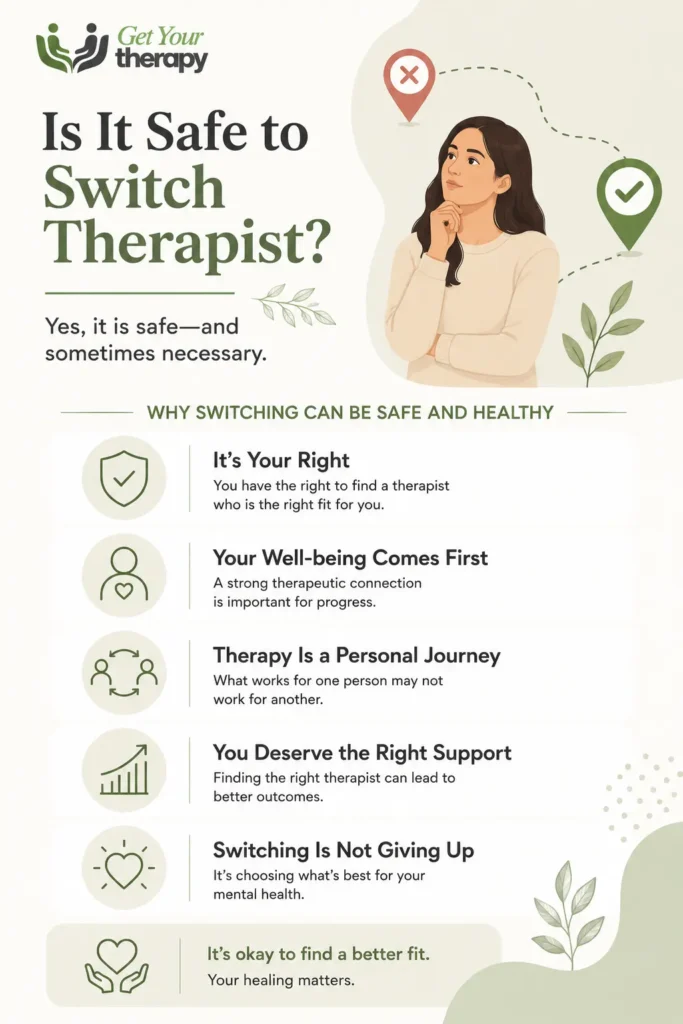
Does Switching Therapists Mean Starting Over?
No. And this is the biggest misconception that keeps people stuck.
When you switch therapists, you take everything with you – the insights you gained, the patterns you identified, the language you found for what you are going through. None of that disappears.
What helps the transition:
- Write down what you learned with your previous therapist – what was helpful and what was not.
- Tell your new therapist upfront: “I have worked with someone before. Here is what I found useful, and here is what I felt was missing.”
- A good therapist will build on your existing self-awareness rather than starting from scratch.
Switching therapists is not starting over. It is starting again with better information.
How to Find a Better Fit After Switching?
The reason your first therapist did not work is useful data. Use it.
Ask yourself:
- Did the approach feel too structured, or not structured enough?
- Was there a language or cultural mismatch?
- Did you need someone with specific expertise – trauma, OCD, relationship issues, work stress – that your previous therapist did not have?
- Did you want someone who challenges you more, or someone who listens more?
Bring that clarity to your next search. On GetYourTherapy, you can filter by approach, speciality, language, and budget so the match is more precise from the start.
Give your new therapist 4 to 6 sessions before judging the fit. The first few sessions with anyone are always intake and groundwork.
Ready to find a better fit?
At GetYourTherapy, switching is simple. Search by concern, language, budget, and approach – and start fresh with a therapist who actually matches what you need.
Find a therapist who is right for you
Read More Here:
- 7 Red Flags That Mean Your Therapist Is Not the Right Fit
- Questions to Ask a Therapist Before You Book
- Free and Low-Cost Therapy in India