

Yes, burnout affects relationships. Emotional exhaustion often leaves people with less patience, less energy to communicate, and less emotional capacity to connect with the people they love. Many couples believe they’re growing apart when, in reality, one partner is experiencing burnout. Recognising this early can help protect both your mental health and your relationship.
Burnout rarely stays at work. It follows you home.
Quick Answer
Burnout affects relationships by reducing emotional energy, increasing irritability, making communication harder, lowering intimacy, and creating emotional distance. The good news is that burnout is treatable, and with the right support, many relationships improve as recovery begins.
In 30 Seconds
Burnout may be affecting your relationship if:
- ✔ You’re snapping over small things.
- ✔ You avoid conversations.
- ✔ You always feel too tired for your partner.
- ✔ You want to be left alone.
- ✔ You feel emotionally disconnected.
If these changes started after prolonged stress, burnout, or not, your relationship may be the real problem.
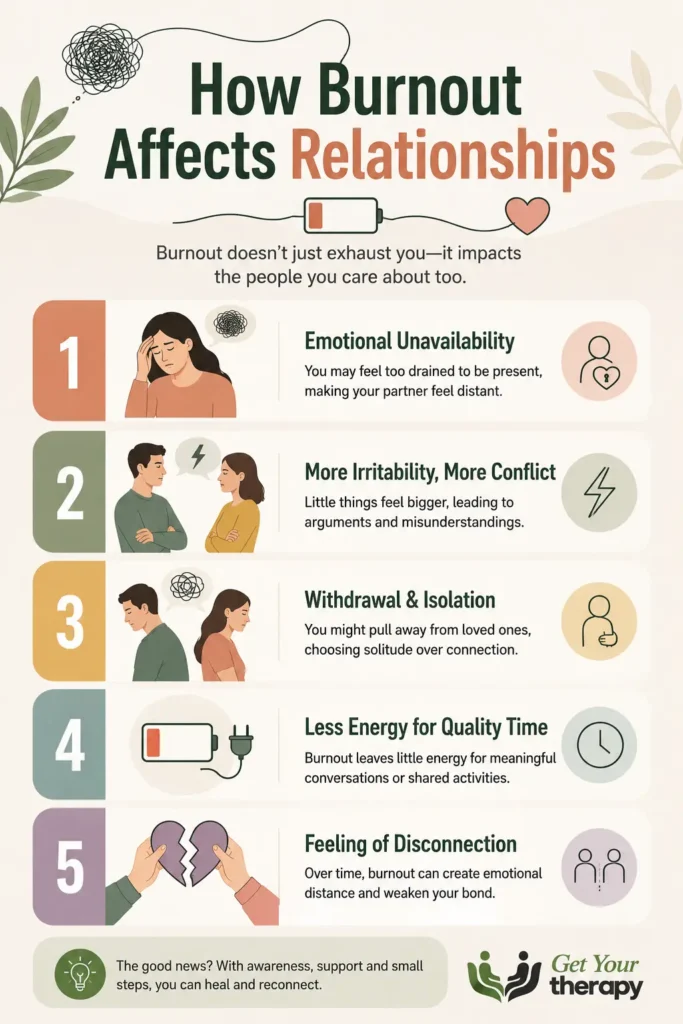
5 Ways Burnout Changes Relationships
1. Small Conversations Start Feeling Like Hard Work
One of the earliest ways burnout affects relationships is through communication.
After spending all day solving problems, answering messages, and making decisions, even simple conversations can feel overwhelming.
You aren’t ignoring your partner because you don’t care.
You may simply have no emotional energy left to give.
Burnout doesn't just steal your energy at work. It often leaves the people you love with whatever energy is left.
2. You Become More Irritable Than You Used to Be
- A simple question.
- A forgotten chore.
- Background noise.
- Things that never bothered you before suddenly trigger frustration.
This isn’t because you’ve become an angry person. Chronic stress keeps your nervous system on high alert, making it much harder to respond calmly.
If arguments have become more frequent, it may be worth asking whether stress in your relationship is driving the conflict.
3. You Start Pulling Away Emotionally
Many people experiencing burnout begin to cancel plans, avoid conversations, or crave more time alone.
Partners often interpret this as rejection.
In reality, emotional withdrawal is one of the most common signs of burnout.
People with burnout don’t usually stop loving their partner. They stop having the emotional capacity to show it.
That’s an important difference.
4. Physical Intimacy May Change
Burnout doesn’t only affect your thoughts.
It affects your body.
Constant stress can reduce energy levels, affect sleep, increase muscle tension, and lower sexual desire.
Many people worry that this means the relationship is failing. Often, it’s simply another symptom of emotional exhaustion.
If you’re also noticing constant tiredness or losing motivation at work, our guide on Signs of Burnout at Work can help you recognise whether burnout may be the underlying cause.
5. You Start Questioning the Relationship
One of the most painful effects of burnout is self-doubt. People often begin wondering:
- “Have I fallen out of love?”
- “Why don’t I enjoy spending time together anymore?”
Before making major relationship decisions, ask yourself another question:
“When was the last time I wasn’t completely exhausted?”
Sometimes your relationship isn’t changing.
Burnout is changing the version of you that’s showing up.
What Can You Do If Burnout Is Affecting Your Relationship?
The first step isn’t trying to become a better partner.
It’s recognising that you’re an exhausted person trying to maintain a relationship with very little emotional energy left.
Burnout recovery and relationship recovery often happen together. Here are a few practical steps that genuinely help.
1. Talk About What’s Happening
Your partner can’t support what they don’t understand. Instead of saying,
“I’m fine.” Try saying,
“I don’t think I’m pulling away from you. I think I’m struggling with burnout.”
That one conversation can replace weeks of misunderstanding.
2. Stop Expecting Yourself to Be “Normal”
Burnout changes your emotional capacity. You may not have the same patience, enthusiasm, or social energy you usually do. That doesn’t mean you’ve failed your relationship.
It means your mind and body are asking for recovery.
You don’t have to be your best self while you’re trying to heal. You just need to be honest about where you are.
3. Protect Time That Isn’t About Work
When burnout takes over, work begins filling every conversation, every evening, and every weekend.
Create small moments where work isn’t allowed.
- Go for a walk.
- Cook together.
- Watch a movie without checking emails.
- Connection doesn’t always require big gestures.
It often returns through small, consistent moments.
4. Don’t Wait Until the Relationship Starts Breaking Down
Many couples seek help only after months of frustration. Burnout is much easier to recover from when recognised early.
If you’re noticing emotional exhaustion, constant irritability, or feeling disconnected from yourself as well as your partner, our guide on Signs You Need Therapy for Burnout can help you decide whether professional support is the right next step.
Can Therapy Help?
Yes. One of the biggest benefits of therapy for burnout is that it not only helps you manage work stress, but it also often improves your relationships.
A therapist can help you:
- Recognise unhealthy stress patterns
- Rebuild emotional resilience
- Improve communication
- Set healthier work-life boundaries
- Reduce guilt around rest
- Reconnect with the parts of yourself that burnout has pushed aside
If you’re unsure how to choose the right professional, our guide on How to Find a Therapist for Burnout in India explains what to look for before booking your first appointment. If you’re wondering whether online sessions are enough, read Online Therapy for Burnout: Is It Worth It? to compare your options.
Common Myth
“If burnout is affecting my relationship, our relationship must be the problem.”
Not always. Sometimes the relationship is struggling. Sometimes, burnout is changing the way you experience the relationship.
Those are very different problems, and they need different solutions.
Before making permanent decisions about your relationship, make sure you’re not making them during temporary emotional exhaustion.
Sources
- World Health Organization (WHO): Burn-out in ICD-11
- American Psychological Association (APA): Stress, Relationships and Mental Health
- Mayo Clinic: Job Burnout – Symptoms and Causes
- Journal of Occupational Health Psychology: Burnout and Interpersonal Relationships
- National Institute for Health and Care Excellence (NICE): Mental Wellbeing at Work