
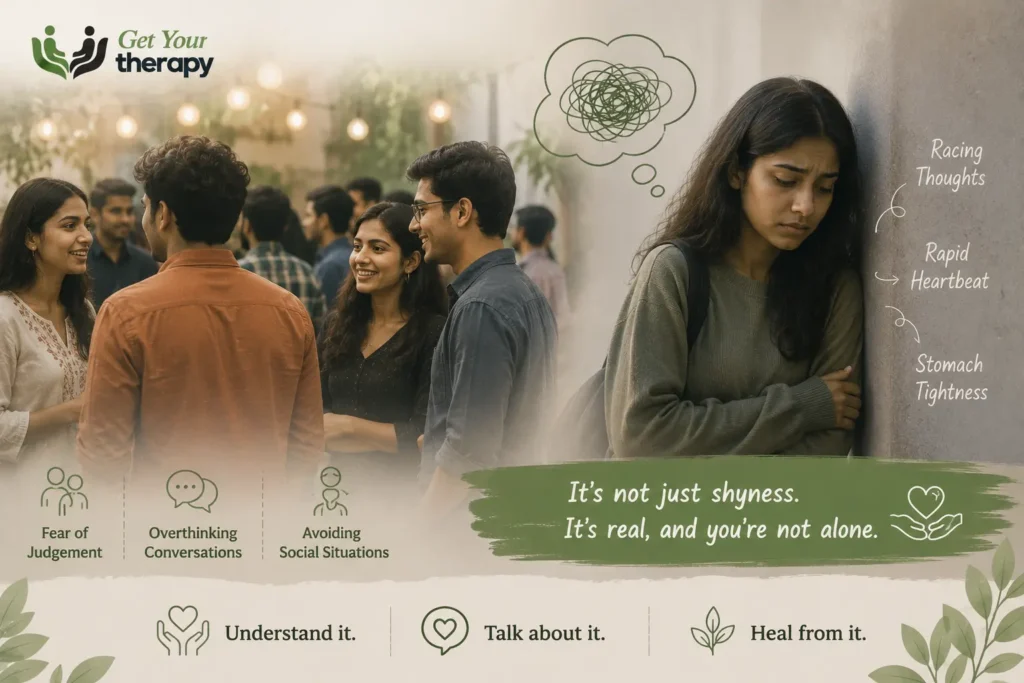
Social anxiety in India is more than feeling shy around new people. It is a persistent fear of being judged, embarrassed or rejected that can make everyday situations such as attending class, speaking in a meeting, answering a phone call or going to a family event feel much harder than they should.
You may want to participate but stay quiet. You may avoid opportunities, then feel frustrated with yourself afterwards. The clearest sign that shyness has become something more is not how nervous you feel; it is how much that fear is limiting your life.
Quick Answer: Is It Shyness or Social Anxiety?
Shyness Social anxiety You may feel awkward at first You expect to be judged or humiliated Discomfort often reduces as you settle in Fear may continue before, during and after the situation You can usually participate despite nervousness You may avoid the situation completely It does not significantly limit your choices It can affect education, work, relationships and daily tasks You may prefer quieter settings You may want to join in but feel unable to The National Institute of Mental Health describes social anxiety disorder as an intense and persistent fear of being watched and judged by others. It usually involves more than temporary nervousness and can interfere with school, work and relationships. (National Institute of Mental Health)
What Does Social Anxiety Feel Like?
Social anxiety is not always obvious from the outside. Someone may appear quiet, serious or uninterested while internally thinking:
- “What if I say something foolish?”
- “Everyone will notice that I am nervous.”
- “What if my English is not good enough?”
- “They probably think I am awkward.”
- “I should stay quiet so I do not embarrass myself.”
The anxiety may begin hours or even days before an event. Afterwards, you might replay the interaction and focus on every pause, expression or sentence that felt imperfect.
Physical symptoms can include:
- a racing heartbeat
- sweating or trembling
- blushing
- nausea or stomach discomfort
- a shaky or unusually quiet voice
- difficulty making eye contact
- feeling that your mind has gone blank
These reactions are part of the body’s anxiety response. They do not mean you lack social skills or confidence as a person.
How Social Anxiety in India Shows Up?
Social anxiety can appear in any culture, but the situations surrounding it are often shaped by where and how you live.
A student may understand the answer but remain silent in class because they fear being laughed at. A job candidate may prepare thoroughly but struggle during an interview or group discussion. A professional may avoid speaking in meetings because they worry about their accent, English fluency or senior colleagues judging them.
It can also appear during:
- College presentations and viva examinations
- JEE, NEET, UPSC or CA interviews and coaching classes
- Office meetings, networking events and client calls
- Weddings and large family gatherings
- Conversations about marriage, salary or career
- Meeting a partner’s family
- Eating, writing or speaking while others are watching
In some Indian families, a quiet child may be described as well-behaved, obedient or simply introverted. That is not necessarily a problem. But when the person is staying silent because of intense fear, not preferring the anxiety can remain unnoticed for years.
Social anxiety commonly begins during childhood or adolescence, making early recognition especially important.
Why Does Social Anxiety Develop?
There is rarely one single cause. Social anxiety may develop through a combination of temperament, past experiences and learned patterns.
Factors that may contribute include:
- Being naturally sensitive to criticism
- Bullying, teasing or public humiliation
- Highly critical parenting or frequent comparison
- Pressure to perform perfectly
- Limited opportunities to socialise safely
- Previous rejection or exclusion
- Growing up in an environment where mistakes attracted strong attention
A difficult social experience does not automatically cause social anxiety. Similarly, someone can develop it without remembering one specific incident.
What often keeps the anxiety going is a cycle of fear, avoidance and temporary relief.
For example, you feel anxious about a meeting, so you pretend your internet is not working and keep your camera off. You feel relieved for the moment, but your mind learns that avoiding the meeting protected you. The next meeting then feels even more threatening.
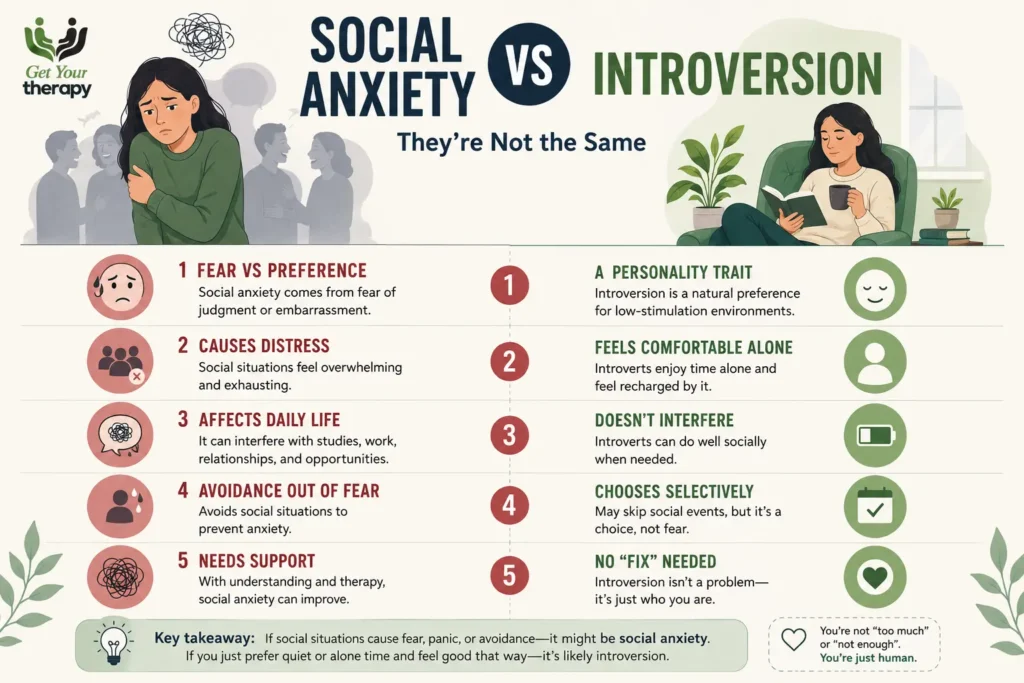
Social Anxiety vs Introversion
Introversion is a personality preference. Social anxiety is driven by fear.
An introverted person may enjoy spending time alone, prefer smaller groups and need quiet time after socialising. They can still speak, meet people or attend events when needed.
Someone with social anxiety may genuinely want friendships, relationships and professional opportunities but avoid them because they expect embarrassment or rejection.
You can also be both introverted and socially anxious. The important question is:
Am I choosing not to participate because I prefer not to—or because fear is deciding for me?
For a broader comparison of anxiety patterns, read Types of Anxiety Disorders: GAD, Social Anxiety, Panic and OCD Explained.
Can Social Anxiety Affect Work, Studies and Relationships?
Yes. Social anxiety can gradually narrow your choices.
You may avoid applying for jobs that require interviews, turn down promotions involving presentations or allow others to take credit because speaking up feels uncomfortable. Students may avoid asking questions, joining activities or attending classes that involve participation.
In relationships, social anxiety can make it difficult to meet people, express interest, discuss needs or believe that someone genuinely likes you. Others may mistakenly interpret silence as disinterest.
The effect is not always dramatic. Sometimes it looks like repeatedly choosing the safest option and wondering later why life feels smaller than you expected.
If exam situations are a major trigger, read Exam Anxiety in India: Why It Happens and How to Manage It.
What Can You Do About Social Anxiety?
Start with one manageable situation
Do not begin with the situation you fear most. Choose a smaller step, such as asking one question in class, making a short phone call or speaking once during a meeting.
Repeat that step until it becomes more familiar, then move to something slightly harder.
Reduce “safety behaviours”
Safety behaviours are things you do to prevent embarrassment, such as rehearsing every sentence, avoiding eye contact, speaking very softly or checking your phone throughout a conversation.
They may help briefly, but they can also reinforce the belief that you cannot cope without them. Try reducing one behaviour at a time rather than removing all of them at once.
Shift attention away from yourself
Social anxiety makes you monitor your voice, face, hands and every word you say. Instead, deliberately focus on the conversation: What is the other person saying? What question could you ask? What is happening around you?
The aim is not to perform perfectly. It is to remain present.
Question the prediction afterwards
Rather than asking, “Was I awkward?”, ask:
- What did I expect would happen?
- What actually happened?
- What evidence suggests people judged me?
- Am I holding myself to a standard I would never expect from someone else?
These strategies can be helpful, but persistent social anxiety often improves faster with structured professional support.
Does Therapy Help With Social Anxiety?
Yes. Cognitive Behavioural Therapy designed specifically for social anxiety is one of the best-supported treatments. It helps people understand anxious predictions, reduce self-focused attention, change avoidance patterns and gradually face feared situations. (World Health Organization)
NICE recommends individual CBT specifically developed for social anxiety as a first treatment option for adults. Treatment commonly includes gradual exposure rather than forcing someone into their most frightening situation immediately.
When choosing a therapist, ask:
- Do you regularly work with social anxiety?
- Do you use CBT and gradual exposure?
- How will we decide which situations to practise?
- What can I expect between sessions?
A therapist should explain the process clearly and work at a pace that is challenging but manageable.
Social anxiety is affecting more than your social life? Our guide on how to find a therapist for anxiety explains what qualifications, experience and treatment approaches to check before booking.
When Should You Seek Help?
Consider speaking with a therapist if fear of judgment:
- Has continued for several months
- Makes you avoid classes, interviews, meetings or events
- Affects friendships, dating or family relationships
- Limits your education or career decisions
- Causes significant distress before and after interactions
- Leads you to rely on alcohol or other substances to socialise
You do not need to wait until you stop leaving home. If social anxiety is regularly making decisions for you, that is enough reason to seek support.
The Bottom Line
Being quiet, private or introverted is not something that needs to be fixed.
The concern begins when fear prevents you from speaking, connecting or choosing the opportunities you actually want. Social anxiety is treatable, and progress does not require becoming the loudest person in the room. It means being able to participate without fear controlling every decision.
At GetYourTherapy, you can explore therapists based on your concern, language, budget and availability.