Couples therapy helps two partners understand recurring relationship problems, improve communication, and decide how they want to move forward. You do not need to be married or on the verge of breaking up to go. Couples in India commonly seek therapy for repeated conflict, loss of trust, communication problems, intimacy concerns, family pressure, or major life changes.
Research across 58 studies found that couples therapy improved relationship satisfaction, communication, emotional intimacy, and partner behavior compared with untreated control groups.
What Actually Happens in Couples Therapy?
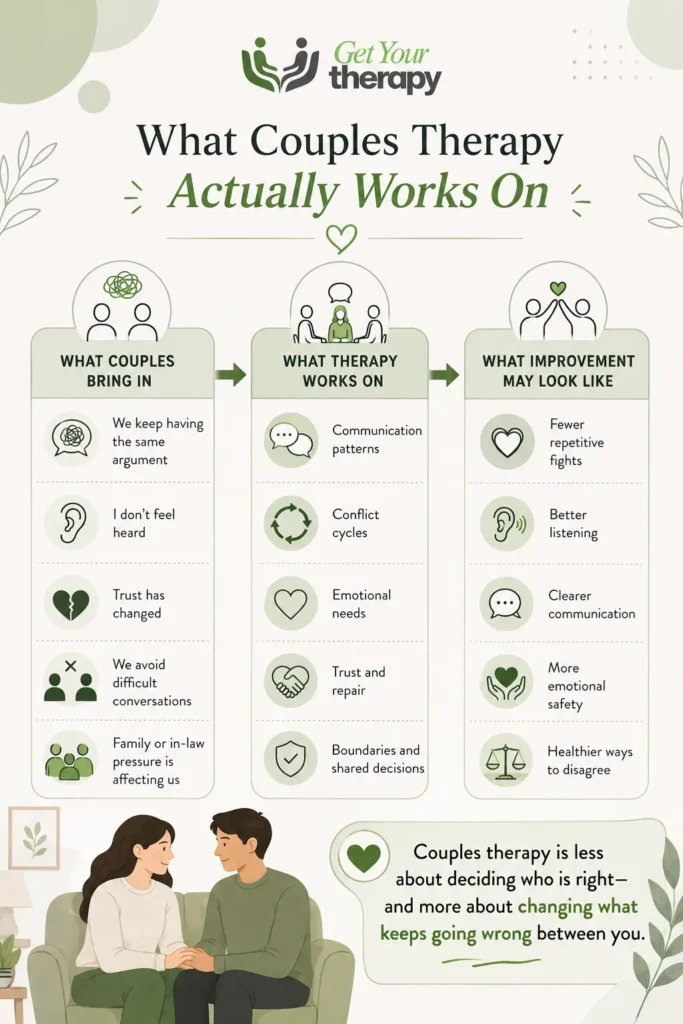
Couples therapy is not two people arguing while a therapist decides who is right.
The therapist looks for patterns between you.
For example:
One partner feels ignored → complains more strongly → the other feels criticised → withdraws → the first partner feels even more ignored.
You may enter therapy arguing about WhatsApp messages, chores or in-laws. The therapist may help you recognize that the deeper cycle is pursuing, withdrawing, feeling unheard, and becoming defensive.
The goal is usually to change that cycle rather than determine who started it.
What Happens in the First Couples Therapy Session?
The first session usually focuses on three questions:
- What brought you here now?
- How does each partner understand the problem?
- What would you like to be different?
Your therapist may ask about:
- how long you have been together
- recurring arguments
- trust and intimacy
- important relationship changes
- family and living arrangements
- previous attempts to solve the problem
- what each partner wants from therapy
Some therapists also speak with partners individually during the assessment process. Ask in advance how they handle individual conversations and information shared privately, so both partners understand the confidentiality policy.
What Problems Can Couples Counselling Help With?
Couples counselling may help when you are dealing with:
- the same arguments repeatedly
- communication breakdown
- emotional distance
- trust after infidelity or dishonesty
- differences around money
- sex or intimacy concerns
- parenting disagreements
- marriage decisions
- separation or uncertainty about staying together
In India, therapy may also involve situations shaped by joint-family living, relationships with in-laws, financial responsibilities towards parents, intercaste or interfaith relationships, arranged-marriage expectations, or disagreements about where and how a couple should live.
A good therapist should understand the context rather than applying generic advice such as “just set boundaries” without considering whether those boundaries are realistic.
Does Couples Therapy Actually Work?
Yes, it can help, but results are not guaranteed.
A large meta-analysis found meaningful improvements in relationship satisfaction as well as communication and emotional intimacy following couple therapy.
Research specifically on Emotionally Focused Couple Therapy (EFT) and behavioural couple therapy also found moderate improvements in relationship satisfaction after treatment.
Therapy tends to be more useful when both partners are willing to:
- talk honestly
- examine their own behaviour
- practise changes outside sessions
- stop treating therapy as a place to prove the other person is wrong
Couples therapy can also help partners decide that separating respectfully is healthier. Staying together is not automatically the therapist’s goal.
How Much Does Couples Therapy Cost in India?
There is no standard national fee.
Current publicly listed prices in India show couples sessions commonly around ₹2,500–₹4,000 per session, although fees vary by therapist experience, location and session length.
Couples sessions may cost more than individual therapy because they can be longer and involve two clients.
Before booking, ask:
“How long is the session, what is the fee, and how often do you usually recommend meeting?”
That tells you more than comparing session prices alone.
Does Online Couples Therapy Work?
Online couples therapy can be a reasonable option, particularly when partners live in different cities, work different schedules or cannot find a suitable couples therapist locally.
It may also make therapy easier for couples who want more privacy or do not live near a specialist.
The important question is less online vs in-person and more whether the therapist has proper couples-therapy experience and whether both partners can participate privately without interruption.
How Do You Choose a Couples Therapist in India?
Do not choose someone simply because their profile says “relationship expert.”
Look for:
Relevant professional training
Check their psychology or psychotherapy qualifications.
If someone describes themselves as a clinical psychologist, you can ask for their Central Rehabilitation Register number and verify their RCI registration. RCI’s current clinical-psychology curriculum includes family, marital, and other psychotherapy work within professional clinical training.
Specific experience with couples
Ask:
“How much of your work is actually with couples?”
A therapist who mainly provides individual counselling is not automatically experienced in managing two people in the same room.
A clear therapy approach
They may use approaches such as:
- Emotionally Focused Therapy
- behavioural couple therapy
- CBT-informed couples work
- Gottman-informed techniques
The therapist should be able to explain how their approach would help your specific problem, not just list certifications.
When Couples Therapy May Not Be the Right Starting Point
Couples therapy assumes both people can speak honestly without being punished afterwards.
If there is ongoing violence, coercion, threats or fear of retaliation, standard couples therapy may not be safe. The National Domestic Violence Hotline specifically advises against joint counselling in abusive relationships because information shared in therapy can later be used against the abused partner.
In that situation, seek individual and specialist support first.
What If Your Partner Does Not Want Therapy?
You cannot force someone to participate meaningfully. You can explain what you want from therapy without making it a threat:
“We’re having the same argument repeatedly and what we’re doing isn’t helping. I’d like us to try a few sessions and see whether we can understand it differently.”
If your partner still refuses, individual therapy can still help you understand your own patterns, boundaries, and decisions.
The Bottom Line
You do not need to wait until your relationship is close to ending.
Couples therapy is most useful when the question shifts from:
“Who is wrong?”
to:
“What keeps happening between us, and how do we change it?”