Online therapy vs in-person therapy is one of the biggest decisions people face when they decide to seek mental health support.
Should you book an online therapist from the comfort of your home? Or is sitting face-to-face with a therapist still the better option?
For many people in India, the answer is not as obvious as it seems.
The good news is that both formats can be highly effective. The real question is which one fits your needs, budget, lifestyle, and comfort level.
In this guide, we’ll compare online therapy vs in-person therapy, look at the latest research, discuss costs in India, and help you decide which option is right for you.
Online Therapy vs In-Person Therapy: Quick Answer
For most people dealing with anxiety, stress, depression, grief, relationship challenges, work burnout, or everyday mental health concerns, online therapy is just as effective as in-person therapy.
Online therapy is often more affordable, easier to access, and offers greater privacy.
However, in-person therapy may be preferable for severe trauma, complex mental health conditions, intensive therapeutic interventions, or situations where physical presence supports the treatment process.
If you’re wondering which therapy is better online or offline, the answer depends less on the format and more on whether you can consistently attend sessions and build a strong relationship with your therapist.
Does Online Therapy Actually Work as Well as In-Person Therapy?
One of the most common questions people ask is:
“Is online therapy effective?”
Research consistently suggests that it is.
A 2021 meta-analysis published in the Journal of Medical Internet Research found no significant difference in outcomes between video-based therapy and face-to-face therapy for common concerns such as anxiety, depression, PTSD, and relationship difficulties.
The reality is simple:
- The format does not make therapy work.
- The relationship with your therapist does.
- That relationship can develop through a screen or across a room.
There are some exceptions. Severe trauma, certain eating disorders, crisis situations, and therapies involving intensive body-based interventions may sometimes benefit from in-person care. Your therapist can help determine whether your situation falls into one of these categories.
Which Therapy Is Better: Online or Offline?
People often search for:
online counselling vs face-to-face
or
Which therapy is better, online or offline?
The answer depends on your circumstances.
If convenience, flexibility, affordability, and privacy are your priorities, online therapy often wins.
If you strongly prefer face-to-face interaction, struggle to engage through screens, or require specialised treatment approaches, in-person therapy may be a better fit.
Rather than asking which format is universally better, ask:
Which format will help me show up consistently and engage honestly?
That answer usually matters more than the setting itself.
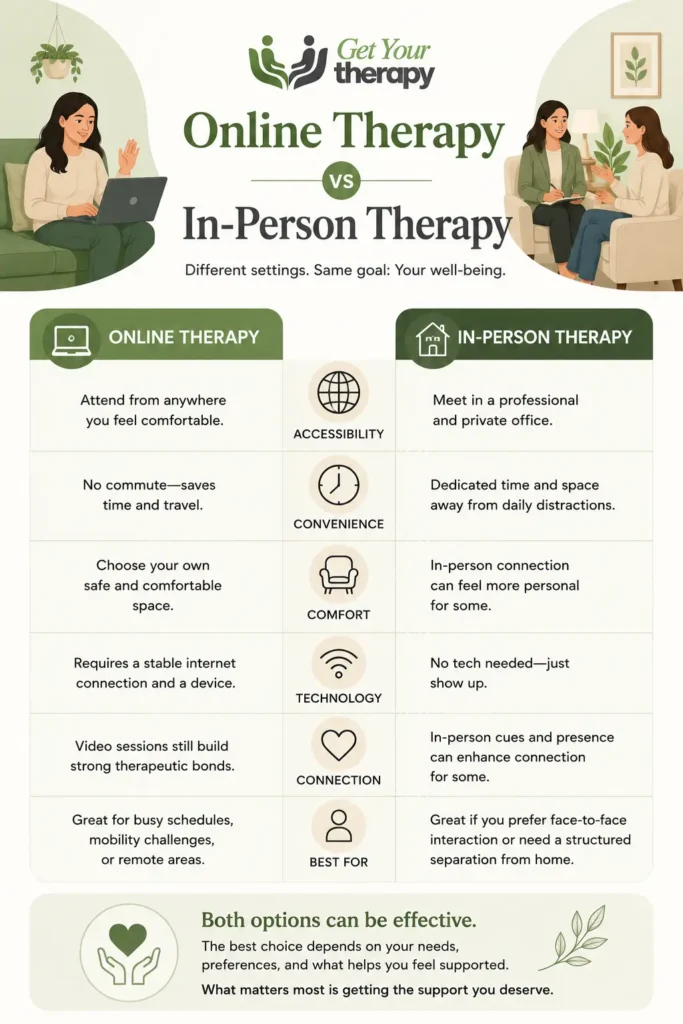
Online Therapy vs In-Person Therapy Comparison
| Factor | Online Therapy | In-Person Therapy |
|---|---|---|
| Cost | Usually lower | Usually higher |
| Convenience | High | Moderate |
| Travel Required | No | Yes |
| Privacy | High | Moderate |
| Access to Specialists | Nationwide | Limited to local area |
| Scheduling Flexibility | High | Moderate |
| Suitable for Anxiety & Depression | Yes | Yes |
| Suitable for Severe Trauma | Sometimes | Often preferred |
| Availability in Smaller Cities | Excellent | Limited |
Cost Comparison: Online Therapy vs In-Person Therapy in India
For many people, cost is the deciding factor.
Average Therapy Costs in India
| Format | Average Cost Per Session |
|---|---|
| Online Therapy – Junior Counsellor | ₹500–₹1,200 |
| Online Therapy – Experienced Psychologist | ₹1,200–₹2,500 |
| In-Person Therapy – Metro Cities | ₹1,500–₹5,000 |
| In-Person Therapy – Tier 2 Cities | ₹800–₹2,500 |
Research suggests online therapy in India can cost 30–50% less than traditional face-to-face therapy.
Over three months of weekly sessions, this difference can amount to ₹15,000–₹30,000 or more.
There is also a hidden expense that many people overlook. A 45-minute therapy session in a busy city like Delhi, Mumbai, or Bengaluru may involve one to two hours of commuting, parking costs, fuel expenses, or cab fares.
When you include those costs, online counselling in India often becomes significantly more affordable.
What Online Therapy Is Better For?
Online therapy works particularly well when:
You Live Outside a Metro City
Access to qualified therapists remains limited in many parts of India.
Online therapy allows you to connect with therapists across the country rather than being restricted to those available locally.
Privacy Matters
Many people still worry about the stigma attached to mental health care. Online sessions remove concerns about being seen entering a clinic or sitting in a waiting room.
Your Schedule Is Busy
Online therapy eliminates travel time and often provides evening, weekend, and early morning appointments.
You Are Managing Common Mental Health Concerns
Online therapy has strong evidence supporting treatment for:
- Anxiety
- Depression
- Stress
- Burnout
- Grief
- Relationship challenges
- Work-related difficulties
You Want to Try Therapy Without a Major Commitment
The lower cost and convenience make online therapy an excellent starting point if you’re unsure whether therapy is right for you.
What In-Person Therapy Is Better For?
In-person therapy also has important advantages.
Complex Trauma Treatment
Many clinicians prefer in-person sessions for certain trauma-focused interventions, especially when intensive grounding techniques are involved.
When Screens Feel Limiting
Some people find it easier to express emotions in a physical room than through a video call.
If you consistently feel disconnected online, in-person therapy may be more effective for you.
Severe Mental Health Conditions
In situations involving severe depression, psychosis, or significant safety concerns, in-person assessment may provide additional clinical benefits.
Children and Adolescents
Younger children often engage more naturally in therapeutic activities, play-based interventions, and structured exercises conducted in person.
What Most Therapists Recommend?
Most therapists today do not view online therapy and in-person therapy as competing options.
Instead, they focus on one important question:
Which format are you most likely to attend consistently?
Research repeatedly shows that consistency, honesty, engagement, and a strong therapeutic relationship contribute more to positive outcomes than the format itself.
A person who attends online therapy regularly is likely to make more progress than someone who continually postpones in-person sessions due to travel, cost, scheduling difficulties, or stigma.
The Factor Most Indian Guides Ignore: Mental Health Stigma
Between 76% and 85% of Indians who need mental health support never receive it.
Stigma remains one of the biggest barriers. Many people worry about:
- Family judgment
- Workplace perceptions
- Community gossip
- Being recognised at a clinic
Online therapy helps remove these barriers.
- There is no waiting room.
- No commute.
- No public visibility.
For many Indians, especially those in smaller cities or conservative environments, online therapy is not simply more convenient.
It is often the reason therapy becomes possible in the first place.
How to Decide: A Simple Framework
Ask yourself these questions:
1. Do I Have Access to Qualified Therapists Nearby?
If not, online therapy is usually the better choice.
2. Am I Seeking Help for Anxiety, Depression, Stress, Grief, or Relationship Concerns?
Both online and in-person therapy can work equally well.
3. Do I Have Severe Trauma or Complex Mental Health Needs?
Discuss this with a therapist. They can help determine whether in-person support would be beneficial.
4. Is Privacy Important to Me?
Online therapy often provides greater privacy and flexibility.
5. Will I Realistically Attend Sessions Consistently?
Choose the option you are most likely to stick with. Consistency matters more than location.
Final Thoughts
For most people, comparing online therapy vs in-person therapy, there is no universally right answer.
Both formats can be effective. The best choice is the one that fits your life, budget, comfort level, and mental health needs.
If online therapy makes it easier for you to start, that is often reason enough to begin there. You can always transition to in-person therapy later if your needs change.
The important step is not choosing the perfect format. It is getting the support you need.
Ready to Find a Therapist?
At GetYourTherapy, you can connect with qualified therapists across India based on your concerns, preferred language, budget, and availability.
Whether you’re looking for online counselling in India or in-person support, finding the right therapist starts with one conversation.