

Red Flag 1: You Feel Judged for What You Share
A therapy room is supposed to be the one place where you speak without filtering yourself. If you are choosing your words carefully because you are afraid of your therapist’s reaction, that is a problem.
This comes up a lot in the Indian context. Therapists who are not culturally aware may unintentionally judge clients for staying in arranged marriages under pressure, for financial dependence on family, or for not “just setting boundaries” with parents. Cultural reality, this is one of the signs of a bad therapist.
You should feel uncomfortable sometimes in therapy – that is the work. You should never feel judged for who you are.
Red Flag 2: Your Therapist Talks About Themselves Too Much
A therapist sharing a brief personal example occasionally is normal. A therapist who regularly talks about their own relationships, opinions, or life problems is making your sessions about them – not you.
If you are coming out of sessions knowing more about your therapist’s divorce or career stress than you explored about yourself, that is a sign of a bad therapist.
Red Flag 3: Nothing Changes After 8 to 10 Sessions
Therapy is not supposed to feel like progress every single week. But after 8 to 10 sessions, you should notice something shifting – sleeping slightly better, reacting less intensely, understanding a pattern you did not see before.
If you feel exactly the same after two months and your therapist has never brought up your progress, goals, or treatment plan – ask them directly. A good therapist tracks outcomes. A bad one lets sessions drift.
This is especially worth watching in India, where many people stay with the first therapist they find because switching feels like starting over. It does not have to be.
Red Flag 4: They Push One Solution for Everything
Some therapists over-rely on a single tool. Every problem gets the same breathing exercise. All sessions end with the same homework. Every concern is met with the same reframe. This is the sign of a bad therapist.
Therapy requires adapting to the person in front of you. If your therapist is running the same playbook regardless of what you bring in, they are not responding to you – they are running a script.
Red Flag 5: They Break Confidentiality Casually
This is rare, but it happens. If your therapist mentions details about other clients – even without names – that is a serious red flag. If they are willing to talk about others, they will talk about you.
In India, where communities are close and mental health stigma is real, a confidentiality breach can have serious social consequences. If this happens, you have the right to report the therapist to the Rehabilitation Council of India (RCI) at rehabcouncil.nic.in.
Red Flag 6: You Feel Pressured to Continue Therapy Indefinitely
A good therapist works toward your independence, not your permanent dependence on them.
If your therapist discourages you from taking breaks, questions your readiness to reduce sessions, or implies you will fall apart without them, that is a boundary issue. Therapy should have a direction. You should always feel like you are moving toward something, not just maintaining access to support.
Red Flag 7: Your Gut Has Been Telling You Something Is Off
This one is not measurable, but it matters.
If you have had a quiet feeling for weeks that something is not right – not just the discomfort of hard work, but a genuine sense of unease about the person you are working with – trust it. Research consistently shows that the therapeutic alliance is the strongest predictor of outcomes. If that trust is not there after a fair amount of time, the therapy will not work, regardless of how qualified the therapist is.
You are not obligated to stay with a therapist just because you started with them.
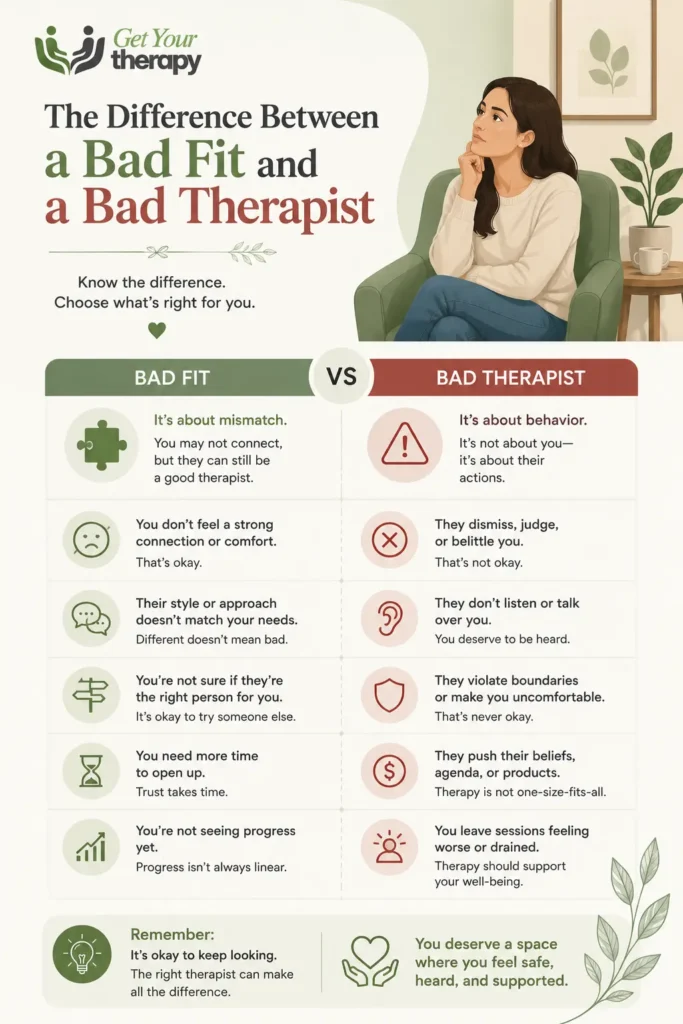
The Difference Between a Bad Fit and a Bad Therapist
Not every red flag means the therapist is unethical. Some mean they are simply wrong for you – different communication style, different cultural frame, different approach. That is a bad fit, not a bad therapist.
A few red flags, however, are serious enough to report, not just leave:
- Sexual or romantic behaviour toward a client
- Sharing your confidential information without consent
- Practising without a valid RCI registration in India
- Threatening, manipulating, or belittling a client
For serious complaints in India, report to the Rehabilitation Council of India (RCI). Globally, report to the therapist’s state or national licensing board.
What to Do If You Spot These Signs?
You have two options – raise it or leave.
Raising it first is worth trying. A good therapist will hear your concern without defensiveness and adjust. That conversation itself can be part of the work.
If that feels unsafe, or if you have tried and nothing has changed, you are allowed to stop and find someone else. Switching therapists is not a failure. It is self-awareness.
- How to Switch Therapists Without Feeling Guilty
- Questions to Ask a Therapist Before You Book
- What to Expect in Your First Therapy Session
Ready to find a therapist who is actually the right fit? At GetYourTherapy, you can search by concern, language, budget, and availability - in India and globally.Find the right therapist for you.
Sources:
- Rehabilitation Council of India – Code of Ethics for Clinical Psychologists, rehabcouncil.nic.in
- Stubbe DE. “The Therapeutic Alliance: The Fundamental Element of Psychotherapy.” Focus (Am Psychiatr Publ). 2018
- Avasthi A, Grover S, Nischal A. “Ethical and Legal Issues in Psychotherapy. Indian J Psychiatry.” 2022
- American Psychological Association – Understanding Psychotherapy and How It Works