Home > Blog > Find a Therapist > Using ChatGPT Instead of Therapy? 7 Signs It’s Time to Talk to a Therapist
Last Updated: August 20, 2026
Using ChatGPT Instead of Therapy? 7 Signs It’s Time to Talk to a Therapist
Find a Therapist
Saisha
Table of Contents
If ChatGPT helps you organize your thoughts, journal, or understand your feelings, you do not necessarily need to stop using it. But if you repeatedly rely on AI for reassurance, diagnosis, major decisions, or support that doesn’t address the problem, it may be time to talk to a therapist.
The use of AI for mental health is already common. A 2026 KFF poll found that 16% of U.S. adults had used AI for mental health information or advice in the previous year.
The important question is not “Is AI good or bad?”
It is:
Is AI helping you move forward, or helping you avoid something that needs human support?
Is AI Enough for What You Are Dealing With?
AI may help with
A therapist may be better when
Organising thoughts
The same problem keeps returning
Journaling
Symptoms affect daily life
Preparing questions
You need a proper assessment
Learning basic coping ideas
You avoid serious situations
Reflecting between sessions
You need constant reassurance
General information
Major decisions depend on the advice
The APA guidance states that generative AI may be useful as a supportive tool but should not replace qualified mental health care.
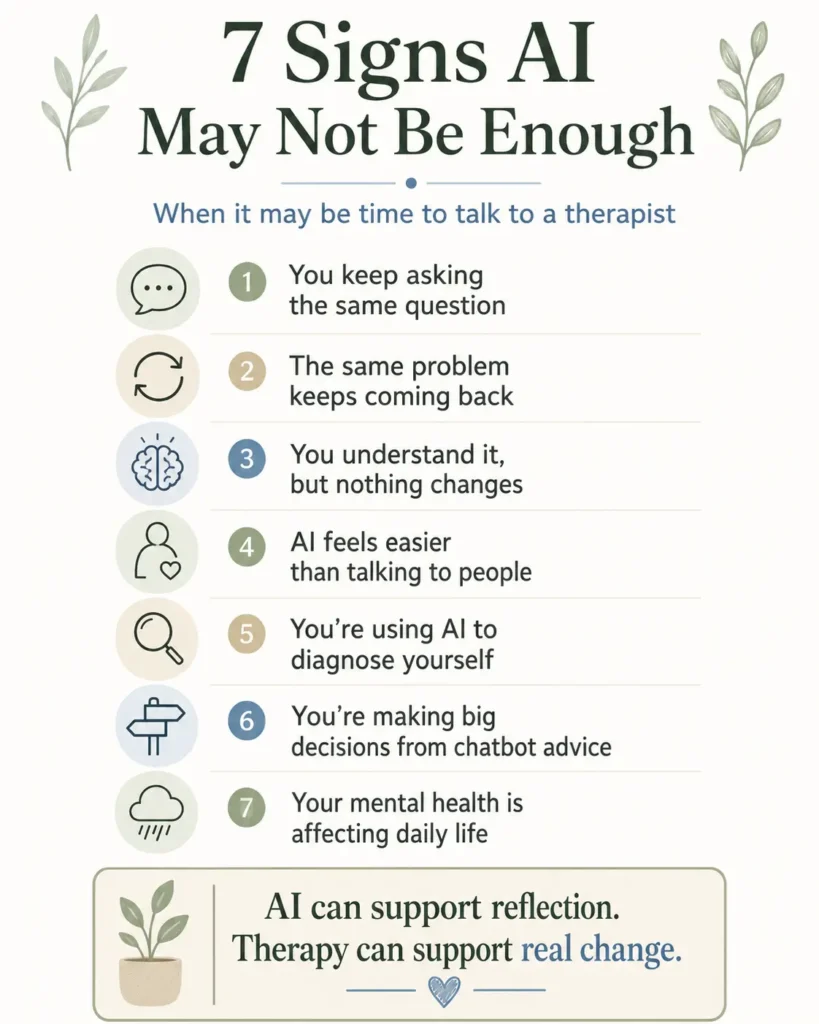
1. You Keep Asking AI the Same Question
You ask: “Do you think my partner is losing interest?”
The answer reassures you.
Twenty minutes later, you ask again with slightly different wording.
If AI gives temporary relief but you repeatedly need more reassurance, the problem may no longer be a lack of information. You may need help understanding why uncertainty feels so difficult to tolerate.
2. You Understand the Problem, but Nothing Changes
AI can be very good at helping you name patterns.
You may already know:
“I overthink.”
“I avoid conflict.”
“I am scared of rejection.”
“I panic when I lose control.”
But knowing the pattern and changing it are different things.
Insight is not always treatment.
Therapy gives you a place to practice responding differently, track what happens, and adjust your approach when the first strategy doesn’t work.
3. The Same Problem Keeps Coming Back
If every difficult week ends with another three-hour AI conversation about the same issue, ask whether those conversations are creating lasting change.
Feeling calmer tonight is useful.
But if the same anxiety, relationship conflict, or avoidance returns tomorrow, you may need more than another explanation.
4. AI Feels Easier Than Talking to Anyone Else
There are understandable reasons why AI may feel easier.
It is available instantly. You can rewrite a question ten times. You do not have to watch someone’s reaction.
The concern begins when AI starts replacing real-world connection rather than supporting it.
OpenAI specifically identifies exclusive attachment to AI at the expense of relationships, well-being, or responsibilities as a concerning pattern of emotional reliance.
If you think, “AI is the only place I can be honest,” that itself may be worth exploring with a therapist.
5. You Are Using AI to Diagnose Yourself
AI can explain ADHD, anxiety, OCD, or depression.
That does not mean it can confirm that you have them.
APA’s 2026 survey found that psychologists were already seeing patients bring AI-generated diagnoses into therapy, and the organization advises verifying AI-generated mental health information with qualified professionals.
Use an AI-generated suggestion as a question to investigate, not a diagnosis to build your identity or treatment around.
6. You Are Making Major Decisions Based on Chatbot Advice
AI can help you think through options.
It should not be the only voice deciding whether you:
End a relationship
Cut contact with family
Quit your job
Change treatment
Make a major financial decision
The higher the consequence of the decision, the more important context becomes.
A therapist can challenge your interpretation, notice patterns across time, and ask questions that may not occur to you or the chatbot.
7. Your Mental Health Is Affecting Daily Life
This is the clearest sign.
Consider professional support if anxiety, low mood, or another concern is regularly affecting:
sleep
work or studies
relationships
eating
leaving home
concentration
your ability to do things you normally manage
At that point, the question becomes less:
“Can ChatGPT help me think about this?”
and more:
“Would proper assessment and ongoing support help me?”
Do You Have to Stop Using AI if You Start Therapy?
No.
AI can still help you journal, organize thoughts, remember what happened between sessions, or prepare questions.
In fact, APA’s 2026 research found that many psychologists are already discussing patients’ use of AI in therapy.
The healthier model is:
AI for reflection. Human therapy for treatment, context, and change.
Yes, with limits. It can help with reflection, journaling, and preparing questions, but important mental-health advice should be checked with a qualified professional.
If the same problems keep returning, symptoms affect daily life, you rely heavily on reassurance or AI is replacing human support, therapy may be more appropriate.
Saisha is a Psychologist and Mental Health Content Specialist at GetYourTherapy. She combines her background in psychology with clear, compassionate writing to create practical mental health content that helps readers understand therapy, emotional concerns, and how to find the right support.