
Quick Answer
Yes, you should usually tell your therapist if you use ChatGPT or another AI chatbot to talk about your mental health. You do not need to share every conversation. What matters is telling them how you use AI, what it helps with, and whether you are following the advice it gives you.
And you are far from the only person doing this. In a 2026 APA survey, 35% of psychologists reported having patients who used AI as an additional mental-health professional.
Why Should You Tell Your Therapist?
Because your AI conversations may contain useful information about what happens between therapy sessions.
Maybe you use ChatGPT when:
- You start overthinking after an argument
- Anxiety gets worse late at night
- You want help putting feelings into words
- You want to understand something discussed in therapy
- You need to organize what you want to bring to your next session
Your therapist does not need to judge the tool. They need to understand what role it is playing in your life.
If you are preparing for your first appointment, you can simply include AI use in what you plan to tell your therapist in the first session.
What Should You Actually Tell Your Therapist?
Keep it simple.
1. What you use AI for
“I use ChatGPT when I’m anxious and want to organise my thoughts.”
That is more useful than simply saying, “I use AI.”
2. How often do you use it
Using a chatbot occasionally to journal is different from needing reassurance from it several times every day.
3. What it helps you do
Maybe it helps you prepare questions, understand a CBT exercise, or remember what happened during the week.
4. What advice do you follow
Tell your therapist if AI has suggested diagnoses, relationship decisions, exposure exercises, or changes related to treatment.
Your therapist can help you decide what is useful and what needs more context.
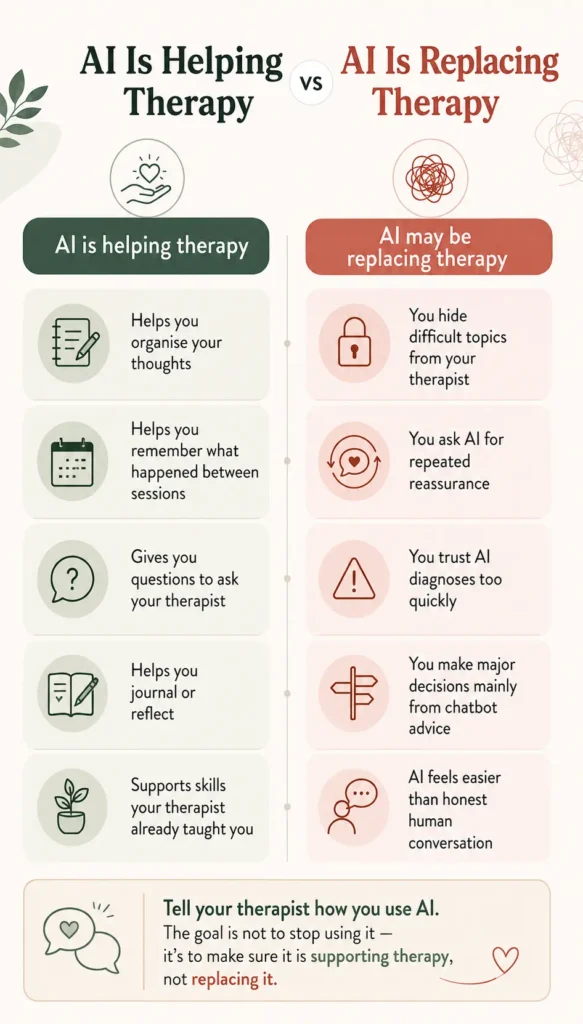
When Is AI Helping Therapy vs Replacing It?
| AI is supporting therapy | AI may be replacing therapy |
|---|---|
| Helps organise your thoughts | You avoid bringing difficult topics to your therapist |
| Helps you remember what happened during the week | You repeatedly ask AI for reassurance |
| Gives you questions for your next session | You trust an AI diagnosis over an assessment |
| Helps practise a technique your therapist already explained | You make major decisions mainly from chatbot advice |
| Makes it easier to talk in therapy | AI feels like the only place you can talk honestly |
This distinction matters because general-purpose chatbots can sound supportive without responding like trained therapists. A 2025 Stanford-led study found that chatbots used more reassurance, affirmation, and suggestions, while therapists asked for more elaboration and context. The researchers concluded that general-purpose chatbots should not be treated as substitutes for trained therapists.
Do You Need to Show Your Therapist Your ChatGPT Conversations?
No. You can summarise them instead:
“I kept asking the chatbot whether my partner was losing interest in me.”
That sentence may tell your therapist more than scrolling through 50 screenshots. But if one response strongly affected you, showing that specific conversation can help you discuss why it felt convincing or important.
What If AI Feels Easier to Talk to Than Your Therapist?
Tell your therapist that, too. It may reveal something useful:
- Are you worried about being judged?
- Is there something you are embarrassed to say aloud?
- Do you need more time to trust your therapist?
- Does AI feel safer because it never challenges you?
Feeling more comfortable with AI does not automatically mean your therapist is wrong for you. But if you consistently feel unable to be honest in therapy, that is worth discussing.
Read How to Get the Most Out of Therapy for more ways to make sessions useful.
What About Privacy?
Be careful about sharing identifiable therapy, health, or relationship information with any AI chatbot.
- For ChatGPT specifically, OpenAI currently allows users to turn off whether future chats are used to improve models. Temporary Chats are not used for training, do not create memories, and are automatically deleted from OpenAI systems after 30 days.
- Other AI products have different policies, so check their privacy settings before sharing sensitive information.
AI conversations also do not automatically have the same professional confidentiality relationship you have with a therapist.
Can AI Interfere With Therapy?
It can, particularly if you use it to avoid uncertainty.
For example:
Therapy: “Let’s sit with not knowing whether they are upset.”
Ten minutes later: You ask a chatbot five times whether your partner’s message means the relationship is ending.
The chatbot may temporarily reassure you, but the reassurance can prevent you from practicing the skill you are working on in therapy.
That is exactly the kind of pattern your therapist should know about.
The Bottom Line
You do not need to choose between using AI and talking to a therapist. The healthier question is:
Is AI helping you reflect between sessions, or is it becoming the place you go instead of doing the difficult work therapy requires?
If you can discuss that openly with your therapist, the AI’s use itself can become useful information for therapy.