

You may need couples therapy when the same problems keep returning, communication has become defensive or avoidant, trust has changed, or your relationship feels stuck despite both of you trying to fix it. You do not have to wait until you are considering separation.
Research across 58 studies found that couple therapy can improve relationship satisfaction, communication, emotional intimacy, and partner behavior.
Here are the signs that matter most.
1. You Keep Having the Same Argument
Every couple disagrees.
The concern is when you have the same fight with different details.
Monday is about dishes. Next week, it is about being late. But underneath both arguments may be:
“I don’t feel considered.”
or:
“Nothing I do feels good enough.”
Couples therapy can help identify the pattern underlying the argument, rather than repeatedly debating who was right this time.
2. You Cannot Discuss Problems Without Becoming Defensive
You bring something up and one person immediately:
- shuts down
- becomes angry
- starts blaming
- leaves the conversation
- brings up old mistakes
- says, “What’s the point? Nothing changes.”
When difficult conversations regularly turn into fights or silence, the issue is no longer only what you disagree about. It is how you communicate when you disagree.
3. You Feel Lonely Even When You Are Together
Relationship problems do not always look like fighting.
Sometimes they look like:
- eating together without talking
- spending evenings on separate phones
- sharing practical updates but nothing personal
- stopping asking each other how you actually feel
A period of distance during a busy month is normal. Persistent emotional disconnection is worth paying attention to.
4. Trust Has Changed
You do not need an affair for trust to become a problem.
Trust can be affected by:
- lying
- hiding money or spending
- broken promises
- secrecy around messages
- repeated boundary violations
- infidelity
When one partner becomes the investigator and the other becomes permanently defensive, trying harder to “move on” often does not resolve what happened.
Therapy can provide a structured space to determine whether trust can be repaired and what that repair would actually require.
5. One of You Keeps Avoiding Important Conversations
Maybe you need to discuss:
- marriage
- children
- finances
- sex
- living with parents
- moving cities
- caring for aging parents
- boundaries with in-laws
But every attempt ends with:
“Not now.”
Avoiding a conversation can reduce tension today while making the decision harder later.
This is particularly relevant for Indian couples when relationship decisions involve not just two partners, but parents, joint-family expectations, financial responsibilities or different cultural and religious backgrounds.
6. Physical or Emotional Intimacy Has Changed
Changes in sex or affection do not automatically mean the relationship is failing.
But if one or both partners feel rejected, pressured, disconnected, or unable to discuss intimacy comfortably, the issue deserves attention.
Couples therapy can help you talk about what changed without turning the conversation into:
“You never want me.”
versus
“All you care about is sex.”
The useful question becomes: What is happening between us that we have been unable to discuss safely?
7. Anxiety, Burnout, or Stress Is Starting to Run the Relationship
Sometimes the relationship is not the original problem.
One partner may be dealing with work stress, anxiety, burnout, or family pressure and gradually become more irritable, distant, or dependent on reassurance.
The other partner may start feeling responsible for managing their mood.
If this sounds familiar, read How Anxiety Affects Relationships or our guide to Burnout and Relationships.
Couples work may help when an individual problem has become a pattern between the two people.
8. You Are Staying Together but Have Stopped Trying to Fix Things
Constant fighting is obvious.
Indifference can be easier to miss.
You may have reached:
- “Do whatever you want.”
- “I don’t care anymore.”
- “There is no point talking.”
When both partners stop expecting anything to improve, the relationship can feel more like coexistence than connection.
This does not automatically mean you should separate. It does mean that waiting without changing anything is unlikely to create a different relationship.
9. You Keep Asking, “Do We Need Couples Therapy?”
Sometimes the fact that you are repeatedly asking the question is useful information.
You do not need:
- A diagnosis
- A dramatic betrayal
- Years of conflict
- One partner to be “the problem”
Couples therapy can also be used before a relationship reaches a crisis.
A 2023 meta-analysis examining couples therapy in typical clinical settings also found improvements in both relationship and individual outcomes, although results varied across studies.
If you have been trying to solve the same issue yourselves and keep arriving at the same place, getting another perspective can be reasonable.

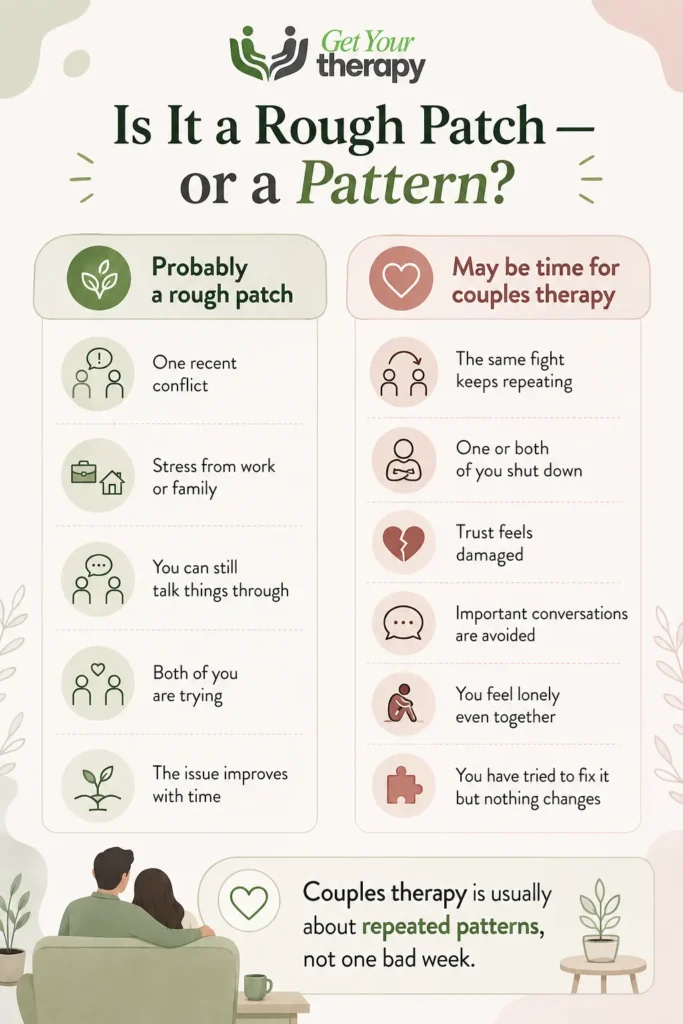
Does My Relationship Need Therapy or Are We Just Going Through a Rough Patch?
Ask three questions:
Is the problem repeating?
A difficult week may pass. A relationship pattern keeps returning.
Is it affecting how we treat each other?
Look at communication, trust, affection, and avoidance.
Have we genuinely tried to change it?
If both of you understand the problem but cannot change the cycle, therapy may help.
For what sessions actually involve, costs, and how to choose someone, read Couples Therapy in India: How It Works, Cost and What to Expect.
When Couples Therapy May Not Be the Right First Step
If there is violence, coercive control, threats, or fear of what your partner may do after a session, standard joint couples therapy may not be safe.
APA guidance notes that couples therapy is not appropriate for every relationship involving intimate partner violence and that safety should be assessed privately before joint treatment is considered.
In India, women experiencing violence can contact the national Women Helpline at 181. For an immediate emergency, call 112.
The Bottom Line
The clearest sign you may need couples therapy is not how often you fight.
It is whether the same relationship problem keeps happening and the two of you no longer know how to change it yourselves.