

Workplace anxiety is persistent worry, fear or tension connected to your job. It may look like dreading Monday, overthinking a manager’s message, repeatedly checking your work or feeling unable to switch off after logging out.
Occasional pressure before a deadline is normal. It becomes a concern when the anxiety continues for weeks, affects sleep or relationships, makes you avoid tasks, or keeps you working far beyond what is required.
Quick Answer: Is It Stress, Workplace Anxiety or Burnout?
| What you notice | It may be |
|---|---|
| Pressure linked to a temporary deadline that settles afterwards | Work stress |
| Fear of mistakes, criticism, meetings or losing your job even when no immediate problem exists | Workplace anxiety |
| Ongoing exhaustion, detachment from work and reduced effectiveness | Burnout |
| Worry that continues across work, health, family and other areas | A broader anxiety pattern |
The World Health Organisation describes burnout as an occupational phenomenon caused by chronic workplace stress that has not been managed successfully. Anxiety is different: it is more strongly driven by fear, worry and anticipation.
Read our guide to Burnout vs Stress: How to Tell the Difference for a closer comparison.
What Are the Signs of Workplace Anxiety?
Work anxiety does not always look like a panic attack. It often hides inside behaviours that are praised as dedication or perfectionism.
Common signs include:
- Feeling tense before opening your laptop or checking messages
- Replaying feedback long after a meeting has ended
- Assuming a short message from your manager means you are in trouble
- Checking work repeatedly because you fear making a mistake
- Avoiding calls, presentations or difficult tasks
- Procrastinating because starting feels overwhelming
- Working excessive hours to prove that you are capable
- Struggling to sleep before the working week begins
- Experiencing headaches, stomach discomfort or muscle tension around work
- Remaining mentally at work after the day has ended
Workplace stress can affect sleep, concentration, mood and physical well-being, particularly when it becomes chronic.
Why Is Workplace Anxiety Commonly Missed in India?
In many Indian workplaces, long hours and constant availability are treated as signs of commitment. Feeling anxious may therefore be dismissed as a normal part of having a demanding career.
The workplace anxiety India pattern can be particularly difficult in:
IT and global client roles
An employee may finish the usual workday and then join calls with teams in the United States or Europe. Irregular schedules and time-zone shifts can disturb sleep, reduce recovery time and affect social and family routines. A small 2025 qualitative study of Indian employees working non-standard hours reported sleep disruption, fatigue and social isolation among recurring concerns.
Startups
Changing priorities, small teams and pressure to move quickly can create uncertainty. When roles are unclear, every delay or mistake may feel more serious because employees do not know how their performance is being judged.
Client-facing jobs
Sales, consulting, account management and customer-support roles may involve targets, difficult clients and frequent evaluation. Anxiety may appear before calls, presentations or monthly reviews.
Hierarchical workplaces
When employees feel unable to question deadlines or discuss workload, anxiety can turn into silent overworking. WHO identifies excessive workloads, limited job control, authoritarian supervision, unclear roles and job insecurity as workplace risks to mental health.
These pressures are not personal failures. Sometimes anxiety is being maintained by your thought patterns; sometimes the workplace itself is unsafe or unreasonable. Often, both are involved.
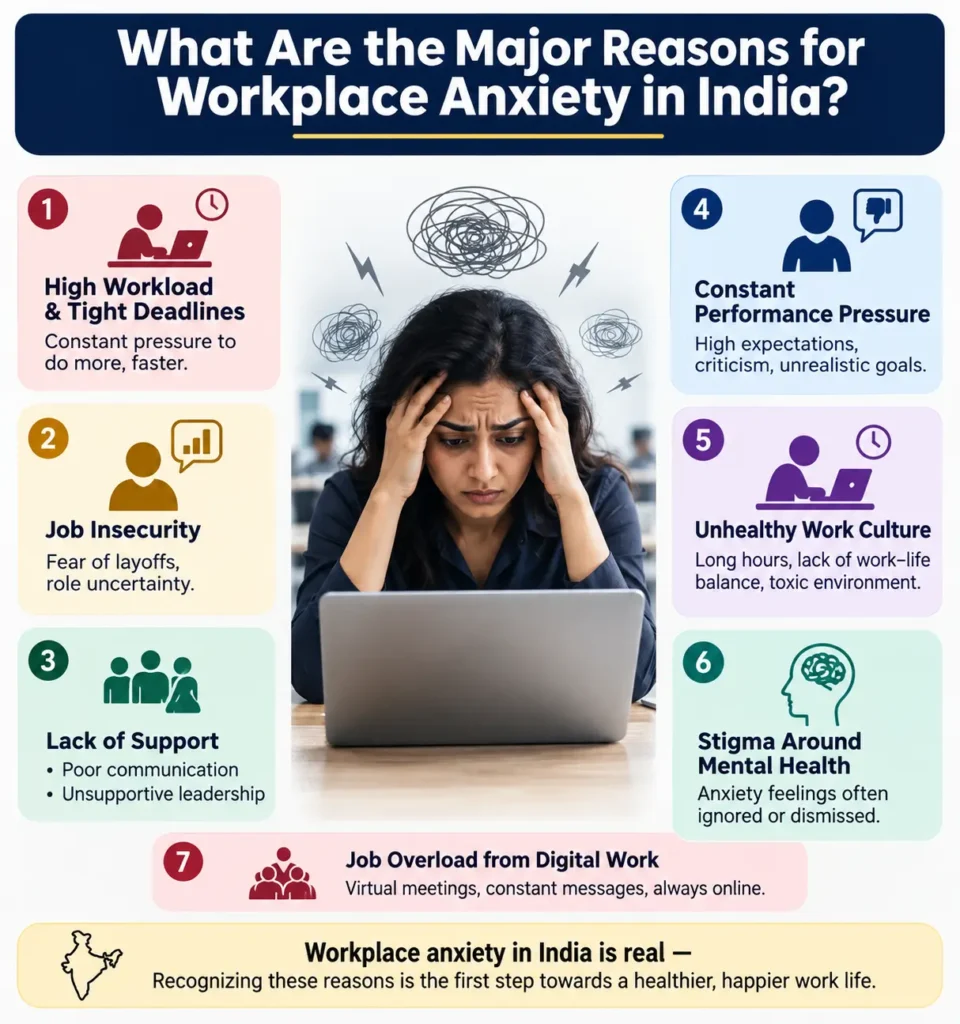
What Is Causing Your Anxiety at Work?
Before trying another breathing technique, identify where the problem sits in your workplace anxiety India.
| Ask yourself | What the answer may suggest |
|---|---|
| Do I mainly fear making mistakes or being judged? | Performance anxiety or perfectionism |
| Is one manager, client or colleague the main trigger? | A relationship or psychological-safety issue |
| Are the deadlines objectively impossible? | A workload or staffing problem |
| Does anxiety continue during weekends and holidays? | It may extend beyond the workplace |
| Do I feel exhausted and detached rather than frightened? | Burnout may be the stronger pattern |
| Am I staying late mainly to reduce guilt or fear? | Overworking may be acting as reassurance |
This matters because an individual coping strategy cannot fix chronic understaffing, bullying or an always-on work culture.
How Can You Cope With Anxiety at Work?
1. Turn vague worry into a specific question
Instead of “I am going to fail,” ask:
- What exactly am I afraid will happen?
- What evidence do I have?
- Is there a practical action I can take today?
- What part of this is outside my control?
This helps separate a real work problem from an anxious prediction.
2. Ask for written priorities
When everything feels urgent, ask your manager to confirm which tasks come first.
You do not need to disclose anxiety. You can say:
“I have three deadlines this week. Which two should I prioritise if all three cannot be completed to the required standard?”
Clear priorities reduce uncertainty and create a written record of expectations.
3. Set one realistic availability boundary
A complete digital detox may not be possible in a client-facing role. Start with one clear rule, such as no non-urgent replies after a set time or protected sleep before an early shift.
For cross-time-zone work, discuss whether late calls can be rotated rather than repeatedly assigned to the same employees.
4. Stop using overwork to feel temporarily safe
Checking a document ten times or staying online so your status appears active may reduce anxiety briefly. But it can teach your mind that constant checking prevented a disaster.
Set a reasonable review limit, submit the work and observe what actually happens.
5. Prepare for predictable triggers
Before a presentation or client call, write down your three main points, practise the opening and take one minute to slow your breathing.
Preparation is helpful. Rehearsing every possible question for hours is usually anxiety asking for certainty that no one can provide.
Should You Tell Your Manager or HR?
You are not required to share personal details before you feel safe doing so.
Before approaching HR, check:
- Whether the conversation will remain confidential
- Who can access Employee Assistance Programme records
- What practical adjustment you are requesting
- Whether you trust your manager to respond appropriately
An exploratory Indian workplace study found that employees may hesitate to disclose mental-health concerns because they fear judgment, loss of opportunities or breaches of confidentiality. Supportive managers and psychological safety made help-seeking easier.
When Can Therapy Help?
Consider speaking with a therapist when work anxiety:
- Continues for several weeks
- Regularly disrupts sleep
- Causes panic or repeated physical symptoms
- Makes you avoid meetings, calls or responsibilities
- Affects your relationships outside work
- Remains intense even during leave or weekends
CBT can help you examine anxious predictions, reduce avoidance and respond differently to feedback, uncertainty and performance pressure.
Read CBT for Anxiety: How It Works and What to Expect in India or explore Anxiety: treatment in India.
The Bottom Line
You are not automatically bad at your job because work makes you anxious.
But anxiety should not be normalised simply because long hours, constant messages and fear of evaluation are common. Identify what belongs to the job, what belongs to the anxiety cycle and what needs to change in both.
Find a therapist for workplace anxiety in India
Sources
- World Health Organisation: Mental Health at Work
- World Health Organisation: Burn-out as an Occupational Phenomenon
- BMC Public Health: Detection and Disclosure of Workplace Mental-Health Challenges in India
- American Psychological Association: Coping With Stress at Work
- Psychological Impact of Time-Zone Shifts on India’s IT Workforce