

Yes, couples therapy can help with communication problems when you keep having the same fights. The goal is usually not to eliminate disagreements. It is to understand the pattern that turns a disagreement into the same argument every time and help both partners respond differently.
A meta-analysis of 58 studies involving more than 2,000 couples found that couple therapy improved relationship satisfaction and also produced significant improvements in communication, emotional intimacy and partner behaviour.
Why Do Couples Keep Having the Same Fight?
Often, the subject changes but the pattern does not. You may argue about:
- Chores
- Money
- Coming home late
- Phones
- In-laws
- Sex
- Parenting
- How much time you spend together
But underneath the argument, something else keeps happening.
For example:
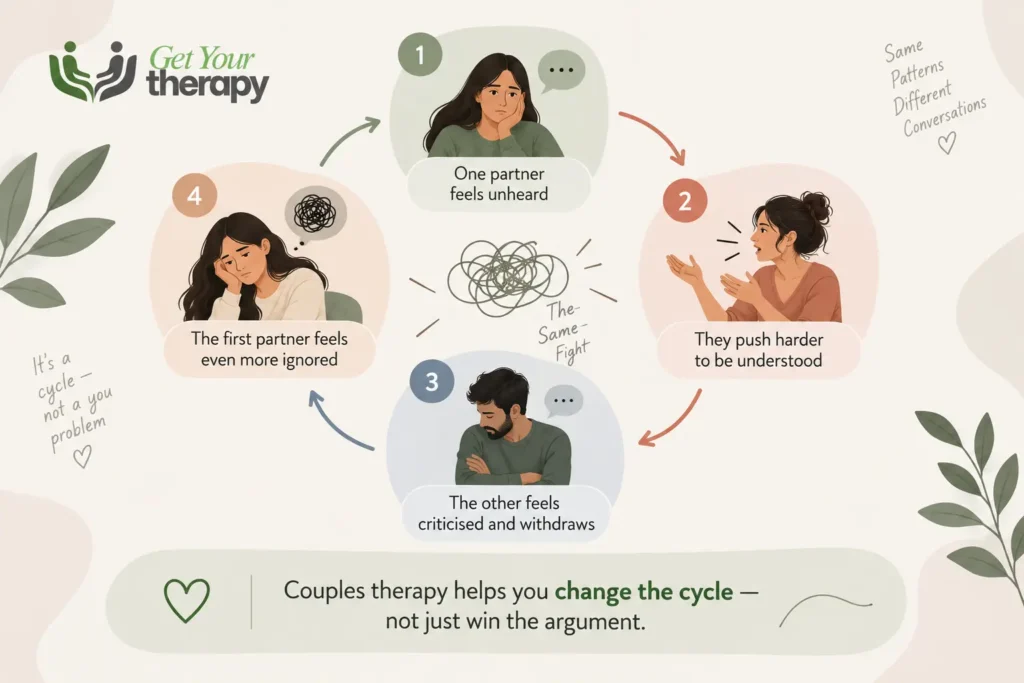
One partner feels ignored → complains → the other feels criticised → becomes defensive or withdraws → the first partner feels even more ignored → complains harder.
Next week, a completely different topic can trigger exactly the same cycle. That is why simply agreeing on who was right rarely fixes repeated arguments.
What Does Couples Therapy Do Differently?
A couples therapist listens to how the argument happens, not only what you are arguing about.
They may notice:
- One person starts conversations with criticism
- One partner interrupts before hearing the full point
- Someone becomes defensive immediately
- One person shuts down when conflict gets intense
- Old arguments are brought into every new disagreement
- One partner keeps chasing a resolution while the other keeps withdrawing
Research examining couples during behavioural couple therapy found that, over treatment, problem-solving and positive communication increased while negative communication decreased.
The therapist then helps you change specific parts of that cycle.
What Might This Look Like in a Session?
Imagine the argument is: “You never spend time with me.”
Your partner hears: “You’re a terrible partner.”
They reply: “Nothing I do is ever enough for you.”
Now the original need-“I miss you and want more time together”-has disappeared.
In therapy, the conversation might be slowed down enough to identify:
What was said → what the other person heard → what they felt → how they reacted.
The goal is not to teach you scripted “perfect communication.” It is to help both partners recognise the moment when a conversation starts turning into the familiar fight.
Can Better Communication Actually Improve a Relationship?
Communication matters, but it is not the whole relationship.
Research shows an association between communication quality and relationship satisfaction, but it also suggests the relationship works both ways: happier relationships may improve communication, while better communication may support satisfaction.
That means couples therapy should not reduce every relationship problem to: “You just need to communicate better.”
Sometimes the real issue is trust, resentment, unequal responsibilities, intimacy, family interference or a disagreement about an important life decision.
Better communication helps you deal with the real problem. It does not make the real problem disappear.
Signs Your Communication Problem May Need More Than Another Conversation
Consider couples therapy if:
- Every disagreement becomes the same argument
- You avoid important subjects because they always end badly
- One person constantly feels criticised
- One person regularly shuts down
- You have started speaking through sarcasm or contempt
- Arguments continue for hours or days without resolution
- You understand the problem but cannot change the pattern
- Communication feels worse despite repeatedly promising to “do better”
Research based on clients’ own experiences of couple therapy found reported improvements in conflict management, communication quality, understanding relationship patterns and ways of relating to one another.
What Can You Try Before Your Next Argument?
Start with the problem, not the accusation
Instead of: “You never care about what I need.”
Try: “We’ve barely had time together this week, and I miss spending time with you.”
The issue can still be serious. You are simply making it easier for your partner to hear the concern without immediately defending themselves.
Stay with one issue
Do not turn: “You didn’t tell me you’d be late.”
into: “And you did the same thing three years ago…”
One conversation has a better chance of being resolved when it stays focused.
Notice when you are no longer listening
If you are only waiting for your partner to stop talking so you can prove them wrong, the conversation has probably stopped being productive.
Pausing and returning to the issue later can be more useful than pushing until somebody gives in.
Indian Couples: When Communication Involves More Than Two People
For some couples in India, arguments about communication are closely connected to:
- Living with parents
- Expectations from in-laws
- Financial support for extended family
- Parenting responsibilities
- Career moves
- Different religious or cultural backgrounds
For example:
“You never support me when your parents interfere.”
may sound like a communication problem, but the deeper issue could be boundaries and loyalty within a joint-family arrangement.
A therapist who understands the context should help you address that actual problem rather than offering generic advice that does not fit your life.
When Will Couples Therapy Not Fix the Problem?
Therapy cannot create change if neither partner is willing to examine their own behaviour.
It also cannot solve fundamental incompatibilities simply by improving communication.
And if arguments involve violence, threats, coercive control or fear of retaliation, standard couples therapy may not be an appropriate first step. Safety and individual specialist support should be assessed first.
The Bottom Line
The topic of your fights may change. The pattern usually changes much less.
Couples therapy can help you identify that pattern and practise a different response before the conversation becomes the same argument again.
For a broader look at what sessions involve, read What Happens in a Couples Therapy Session? or 9 Signs You May Need Couples Therapy.
Find a couples therapist in India
Sources
- Meta-analysis of 58 couple-therapy studies
- Client-reported outcomes of couple therapy
- Observed communication during behavioural couple therapy
- Reviewed by: Samya Kansal on 15/09/2026