

Anxiety can affect relationships by making you overthink small changes, seek repeated reassurance, avoid difficult conversations or become more irritable when you feel uncertain. Your partner may then feel confused, helpless or responsible for keeping you calm.
That does not mean anxiety will ruin your relationship. The useful question is: Is anxiety starting to make decisions for both of you?
How Does Anxiety Affect Relationships?
Anxiety often enters a relationship quietly.
You might:
- Ask repeatedly whether your partner is upset.
- Assume a delayed reply means something is wrong.
- Replay arguments long after they are over.
- Need frequent reassurance that the relationship is okay.
- Avoid conversations because you fear conflict.
- Become irritated when your partner cannot give you certainty.
- Cancel plans because anxiety feels easier to manage at home.
None of these behaviours makes someone a bad partner. But when they happen repeatedly, they can create a cycle that becomes tiring for both people.
Research involving romantic couples found that higher attachment anxiety was associated with more daily excessive reassurance-seeking, while lower relationship trust was also linked with more reassurance-seeking.
What Does the Anxiety Cycle Look Like?
Imagine your partner normally sends long messages but replies:
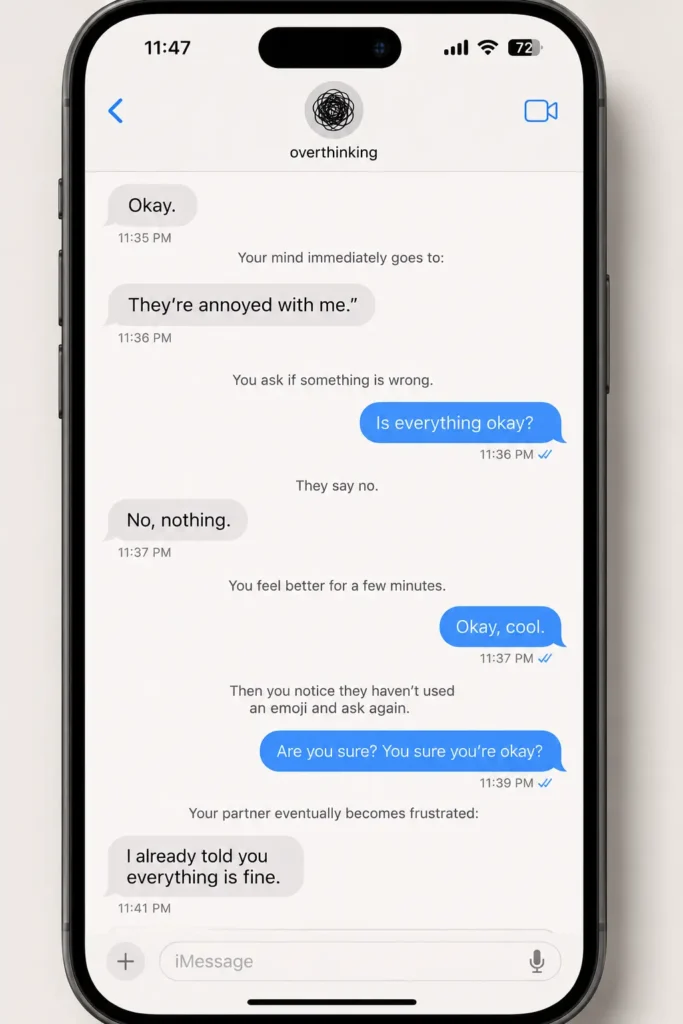
The cycle becomes:
Uncertainty → anxious thought → reassurance → temporary relief → doubt returns → more reassurance
The reassurance itself is not the problem. Everyone needs reassurance sometimes.
It becomes unhelpful when reassurance is the only way you can feel safe, because the relief usually does not last.
Relationship Anxiety vs Anxiety Affecting Your Relationship
These sound similar but are not exactly the same.
| Relationship anxiety | Anxiety affecting your relationship |
|---|---|
| Worry is mainly about your relationship | Anxiety may already affect several areas of life |
| “Do they still love me?” | “I’m overwhelmed and taking it out on my partner.” |
| Fear of rejection or abandonment is central | Work, health, social or general anxiety spills into the relationship |
| You closely monitor your partner for signs that something is wrong | You may withdraw, seek reassurance or become irritable when anxious |
You can also experience both.
If anxiety affects work, health, social situations and relationships, our guide to anxiety and treatment in India can help you understand the wider pattern.
Is It Anxiety or Is Something Actually Wrong in the Relationship?
This distinction matters. Not every uncomfortable feeling is “just anxiety.” Anxiety may be playing a larger role when:
- Your partner has reassured you, but the fear repeatedly returns.
- Your worry is mostly based on what might happen.
- Small changes in tone or behaviour feel much more threatening than usual.
- Similar fears have appeared across previous relationships.
But your concern may be responding to a real relationship problem if your partner repeatedly:
- Lies to you.
- Breaks agreed boundaries.
- Disappears without explanation.
- Threatens to leave during conflict.
- Controls who you meet or what you do.
- Behaves unpredictably in ways that damage trust.
You do not need to label every concern as overthinking. Ask:
“What evidence am I reacting to, a repeated behaviour, or a feared possibility?”
Sometimes the answer is both.
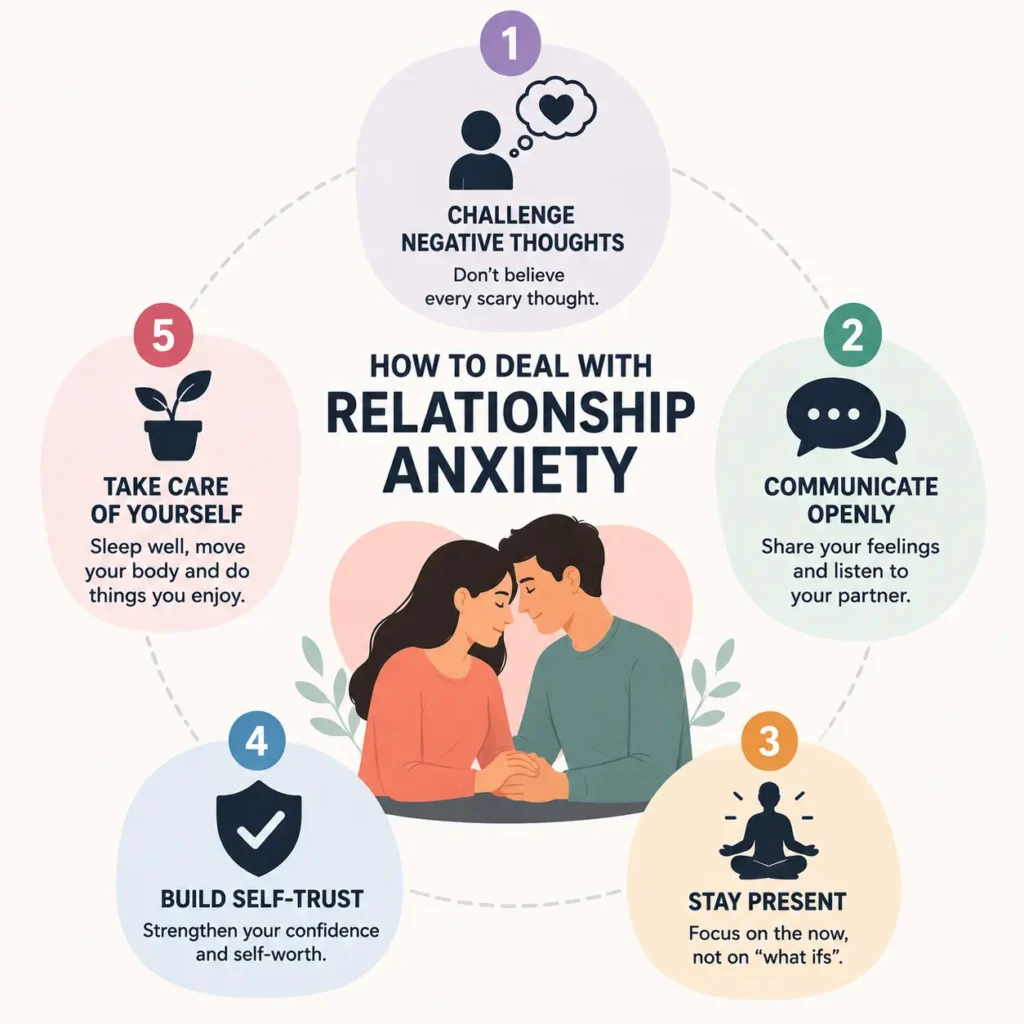
How Can You Stop Anxiety From Taking Over the Relationship?
1. Name the anxiety before asking for reassurance
Instead of immediately asking:
“Are you angry with me?”
Try:
“I’m noticing I’m worried that you’re upset. Is there something we need to talk about?”
The second version opens a conversation without asking your partner to repeatedly prove everything is okay.
2. Ask directly for what you need
Anxiety can turn needs into tests. Instead of becoming distant to see whether your partner notices, say:
“I’ve had a difficult day. Can we talk for ten minutes?”
Clear communication gives your partner something they can actually respond to.
3. Don’t make your partner responsible for removing every uncertainty
Your partner can support you. They cannot guarantee that you will never argue, feel disappointed or face uncertainty.
Research on anxiety-related accommodation shows that family members and partners can begin changing their own behaviour by providing repeated reassurance or taking over avoided activities to reduce someone’s anxiety. While well-intentioned, this kind of accommodation can reinforce anxiety patterns over time.
4. Notice what anxiety is making you avoid
Maybe you avoid discussing money, meeting your partner’s family, going to social events or talking about the future because those conversations make you anxious.
Avoidance gives short-term relief but leaves the problem waiting.
Start with the smallest conversation you can manage rather than waiting until you feel completely calm.
How Can You Support a Partner With Anxiety?
You do not need to become their therapist.
You can:
- Listen without immediately trying to fix everything.
- Ask, “Do you want reassurance, advice or just someone to listen?”
- Avoid dismissing the fear with “you’re overthinking again.”
- Keep reasonable boundaries around repeated reassurance.
- Encourage professional support when anxiety is controlling everyday life.
Supporting someone and organising your entire relationship around their anxiety are different things.
When Can Therapy Help?
Therapy may be useful when anxiety repeatedly causes conflict, reassurance-seeking, avoidance, jealousy or withdrawal or when your partner has started feeling responsible for managing your emotions.
An Indian clinical study involving couples where one partner had an anxiety disorder found better marital adjustment when individual CBT was combined with behavioural marital therapy than with standard care alone. It is one study, not proof that every couple needs couples therapy, but it supports involving relationship patterns when anxiety is affecting both partners.
You can learn how individual therapy works in CBT for Anxiety: How It Works and What to Expect in India or read How to Find a Therapist for Anxiety.
The Bottom Line
Anxiety does not only affect the person experiencing it. It can change how two people communicate, argue, make plans and respond to uncertainty.
The goal is not to stop needing your partner. It is to make sure anxiety is not running the relationship for both of you.