You can manage anxiety without medication, particularly when symptoms are mild to moderate. The approaches with the strongest evidence are not quick “anxiety hacks”; they involve changing anxious thought patterns, reducing avoidance, gradually facing fears, and practicing structured coping strategies consistently.
If you already take prescription medication, do not stop or reduce it based on this article. Discuss any changes with your prescriber.
Quick Answer: What Actually Helps With Anxiety?
| Strategy | What it helps with |
|---|---|
| CBT techniques | Anxious thoughts and predictions |
| Gradual exposure | Avoidance and fear |
| Structured self-help | Building practical coping skills |
| Relaxation | Physical tension and arousal |
| Regular movement | Overall anxiety symptoms |
| Better sleep and less caffeine | Factors that can intensify anxiety |
You do not need to do all six at once. Start with the pattern causing the biggest problem.
1. Stop Treating Every Anxious Thought Like a Fact
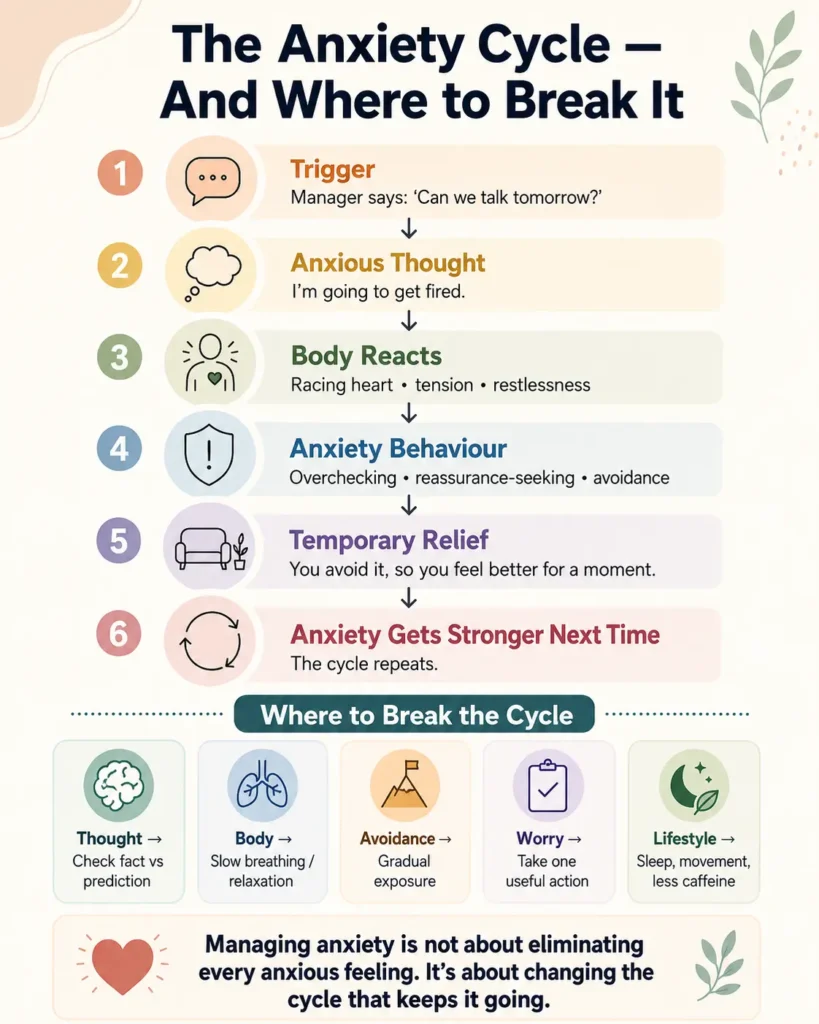
Imagine your manager messages:
“Can we speak tomorrow?”
Your mind immediately decides:
“I’ve done something wrong.”
Before anything has happened, you are replaying your work, checking emails, and imagining that you’ve lost your job.
Try separating the fact from the prediction:
- Fact: My manager wants to talk tomorrow.
- Prediction: I’m going to be criticized or fired.
- What do I actually know? I don’t know what the meeting is about yet.
This is a basic CBT principle: rather than forcing yourself to “think positively,” you learn to question whether your first anxious interpretation is the only possible one.
For a deeper explanation, read CBT for Anxiety: How It Works and What to Expect in India.
2. Notice What Anxiety Is Making You Avoid
Avoidance gives anxiety short-term relief.
- You skip the presentation → anxiety drops.
- You cancel the social plan → anxiety drops.
- You ask someone else to travel with you → anxiety drops.
The problem is that your brain never gets the opportunity to learn:
“Maybe I could have handled that.”
Instead of forcing yourself into your biggest fear, take a smaller step.
If speaking in meetings makes you anxious:
- Ask one question in a small meeting.
- Give a one-minute update next time.
- Gradually work towards a longer presentation.
Gradually facing feared situations rather than continually avoiding them is one CBT-based technique for anxiety
3. Turn Worry Into Either an Action or Nothing
Anxiety is very good at producing questions that cannot actually be solved.
- “What if I fail?”
- “What if they judge me?”
- “What if something goes wrong?”
Ask yourself:
Can I do something useful about this today?
If yes, turn it into one action.
“What if I fail the interview?”
→ Practice five interview questions.
“What if I forget everything during the exam?”
→ Complete a one-time mock paper.
But if the question is:
“What if everyone secretly dislikes me?”
There may be no useful action that can give you complete certainty.
Notice the worry instead of spending another hour trying to solve an unknowable future.
4. Calm Your Body When Anxiety Is Physical
Sometimes you know you are safe, but your body hasn’t caught up.
Try simple strategies such as:
- Slowing your breathing
- Relaxing your jaw and shoulders
- Progressive muscle relaxation
- Grounding yourself in what you can see, hear, and feel
WHO says relaxation and mindfulness-based stress-management techniques may help adults with generalized anxiety or panic disorder, although the evidence is less certain than it is for CBT-based treatment.
That distinction matters.
Breathing exercises can help you settle your body. They should not be presented as a cure for an anxiety disorder.
😇Want to talk through what’s making you anxious right now?
Try Soululu, an AI emotional wellness companion for reflecting on thoughts, feelings, and everyday stress. It isn’t a replacement for therapy, but it can help you slow down and organize your thoughts.
Talk to Soululu →
5. Move Regularly Without Turning It Into Another Goal to Perfect
You do not need a specific “anti-anxiety workout.”
- Walk
- Cycle
- Do yoga
- Strength train
- Dance
Choose something you can realistically continue.
WHO notes that regular physical activity can reduce symptoms of anxiety and also support sleep and overall well-being.
A 20-minute walk you actually take is more useful than a complicated one-hour routine you keep postponing.
6. Check Your Caffeine and Sleep
If anxiety already makes your heart race or leaves you feeling restless, several coffees or energy drinks may make those sensations harder to manage.
NIMH notes that reducing caffeine and getting adequate sleep may help reduce anxiety symptoms when used alongside appropriate treatment.
You do not necessarily need to quit coffee completely.
Test it. For one or two weeks:
- Avoid caffeine late in the day.
- Reduce the amount if you drink several cups.
- Keep your wake-up time reasonably consistent.
- Notice whether physical anxiety or sleep changes.
Treat it like an experiment rather than another rule you have to follow perfectly.
7. Use Structured Self-Help, Not Endless Mental Health Content
Reading about anxiety can help you understand it. But understanding anxiety and changing your response to anxiety are different things.
WHO’s 2026 guidance describes psychological self-help as an evidence-based approach that uses structured exercises and techniques, either independently or with support.
So instead of saving 40 anxiety reels, choose one structured approach and practice it consistently. A useful weekly plan might be:
- Identify one repeated anxious thought
- Reduce one avoidance behavior
- practice one difficult situation
- Track what happened
- Review whether your prediction came true
That gives you information you can actually use.
When Is Self-Help Not Enough?
Self-help is useful, but it should not become another reason to delay support. Consider talking to a therapist if anxiety:
- Has continued for weeks or months
- Causes repeated panic attacks
- Significantly disrupts sleep
- Affects work, studies, or relationships
- Makes you avoid important parts of life
- Continues getting worse despite your efforts
Psychological treatment does not mean medication is your only next option. CBT, structured self-help, and other psychological interventions are recognized treatments for anxiety.
If you are unsure where to start, read How to Find a Therapist for Anxiety in India.
Read Anxiety Medication in India: What You Need to Know Before You Start if you are comparing your options.
The Bottom Line
Managing anxiety without medication is less about finding a trick that makes anxiety disappear and more about changing what keeps the anxiety going.
Start small: question one prediction, face one thing you have been avoiding, move your body, and practice consistently.
If anxiety continues to control your choices despite doing these things, you do not have to keep trying to manage it alone.